This picture comes courtesy of the Chilean volcano that decided, after 9000 years, to get its groove on again. Apparently, this type of ash cloud and eruption are called 'dirty eruptions'. Even so, it looks glorious.
Showing posts with label photography. Show all posts
Showing posts with label photography. Show all posts
Wednesday, May 07, 2008
Coolest Photo of the Day

Tuesday, February 26, 2008
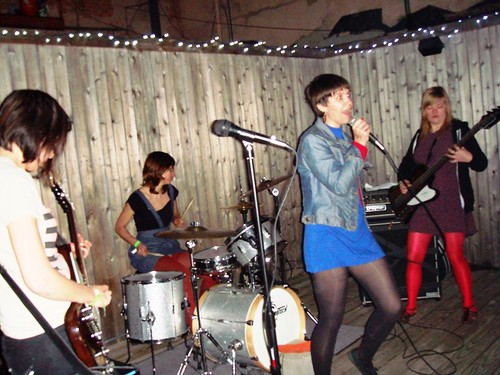
Three Days Later - Review: Finally Punk
Sunday, February 17, 2008
Photos of the Universe as Hyperrealist Art

Personally I think this kind of art falls under the category of hyperrealism as it offers details of the world, or universe in this case, that would otherwise remain unknown to the eyes. That the radiation given off by the Cat's Eye Nebula is invisible to the naked eye is key to my believe that photos taken by the Hubble telescope belong to the realm of hyperrealist art, even if they are only photos taken with particular kinds of lenses. It's exactly that kind of human manipulation of the visual that makes this kind of art hyperrealistic versus abstract. These images are real, just presented in a way that we would have never seen before. That and I just love me some space porn like this.
Sunday, February 03, 2008
Travels in Hyperrealism

Jacques Bodin @ Wikipedia
Hyperrealism @ Wikipedia
Jean Baudrillard @ Wikipedia
The photo you see here is not a photo. The subject is not real in the sense of a photographed subject. Instead, both the photo and the girl are subjects of a painting by hyperrealist artist Jacques Bodin. An offshoot of the Photorealist movement from the 60s and 70s, hyperrealism differs in both narrative structure and the use of technology to paint or sculpt subject at a level of detail that goes beyond what a 35mm camera could accomplish. The hyper in hyperrealism is taken literally as most works of hyperrealism are produced to a level of detail far beyond that of real life. The dimensions of the finished product go far beyond reality as well. Most paintings and sculptures are done at an almost absurd scale. Thus by paradoxically enlarging then magnifying the detail of their subjects, hyperrealists artists amplify reality to a point of non-reality.
The original photorealists were influenced by semiotician and cultural critic Jean Baudrillard. Basing his ideas on language and semiotics around the idea that an object's meaning is determined by its prestige in relation to other mundane objects. While not as simple as Wittgenstein's formulation it does share traits such as the need for context and relation to other elements in the world. Where Baudrillard breaks with such older theories and joins with his contemporaries Foucault, Lyotard and Lacan in his postmodernist thinking about how reality is perceived and treated in the larger-scale social structure. It is on this point that Baudrillard intersects with the photorealists and hyperrealists. As the relation between object and subject becomes magnified to the point of absolute minutia as the subject (people, you and I), in attempt to gain a total understanding of all reality, becomes lost. Once lost, the subject ends up creating a simulation of reality in their mind. Reality, in this sense, becomes non-reality and to the subject the simulation is more real.
I don't buy most of it, since I never bought into Berkeley's idealism or the theory that perception is so fallible that we never have a truly unmediated experience of reality. Then again, I think Baudrillard did have an understanding of how technology like virtual reality and social networks create a simulated reality that, for some people, becomes more real than the real world itself. The acronym IRL (in real life) is a pretty convincing point of evidence for Baudrillard. Even so, to say that an unmediated experience of the real is, for all intents and purposes, impossible goes beyond what I'm willing to accept as a sentient creature whose grey matter is based on a lizard brain. If you can prove to me that lions chasing down gazelle are also seeing a simulation of reality versus an unmediated reality then perhaps I'll buy into Baudrillard.
But despite my criticism of Baudrillard, his influence on the artistic movement of hyperrealism does expose some of the flaws in the human experience. There are grey areas of experience where we have difficulty telling between the real and and non-real. Our perceptions and beliefs are prone to trickery but this has long been known. It's our ability to winnow out the real and non-real that make the human mind an amazing organism.
Friday, February 01, 2008
Trifecta

Early Visual Media Archeology - David Pescovitz @ BoingBoing
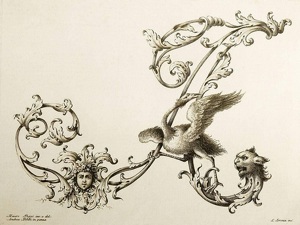
Ornamental Typography - David Pescovitz @ BoingBoing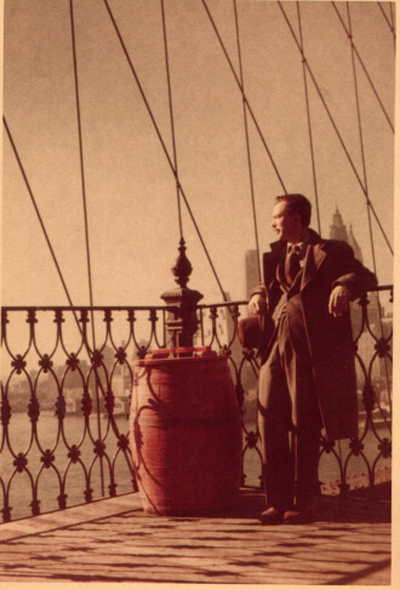
Thursday, January 24, 2008
Photo-Realism on the Cheap
Bic Art - Andrew Sullivan
Sometimes the only reason I read Sullivan's blog is for the random piece of culture that pops up. This is Bic Art; i.e. art created through the use of a Bic pen. That's right, a pen, ball-point, with the annoying little cap that you always lose. The artist is one Juan Francisco Casas, who's web site is in Spanish, but you savvy interweb users should make it through.

Thursday, December 13, 2007
Surreal Imagery Made Happy
Chromasia via Photoblogs
What a strange but obvious way to promote one's photography. It's all very Zen-like so that makes it perfect for me.
Subscribe to:
Posts (Atom)