This is your brain on drugs - Michelle Cottle @ TNR
I've often wondered what the implications of brain-enhancing drugs might have on the intellectual world. Most of the basic questions surrounding the use of Provigil and Adderall are whether students should have regular, non-prescriptive access to such drugs and whether professors should take the use of such drugs into consideration when grading papers. Personally, after seeing many students perform at their typical level but for a longer period of time on these types of drugs I don't believe it is a serious issue. However, and you saw this coming, what of drugs that might enhance cognitive function beyond the norm? If an average student can take a drug that makes them an above-average student then does that negatively impact the student, the class and the way a professor can fairly assess the performance of the class overall? What of competitions such as chess matches where the use of cognitive-enhancement would give a player an edge over the competition, or whether the rest of the competition is on such enhancements themselves? When being assessed for applications, scholarships, tenures or other such life-enhancing positions, what role can we put cognitive-enhancement in?
For those of you who think that academia is not a competitive place then take a quick glance at grant allotments and professorial pay. Academia is very competitive, from undergrad to tenureship, and people will look for anything that could give them the edge to make it pass someone else for the prestigious scholarship, the highly-regarded research award or the continuation of funding for your academic work. Unlike sports where professional players only have a decade at most to make their mark, academics are in it for the long haul. This is not a past-time for them, it is a career. And when the difference between taking a trip to Oslo for that Nobel prize or sitting in some backwater community college is a simple cognitive-enhancement drug it's obvious what any sane person would do.
Even so, curiousity gets the better of me. What are the potentials of such drugs? Can a simple drug treatment turn a 130 IQ into a 150? Could we have cadres of scientists all working at the levels of a Bohr or an Einstein? Or how about historians who can grasp the sub-disciplines of economic history, social history, cultural history, political, military, micro, diplomatic or every other kind of history all at once? What kind of groundbreaking works could they produce? Could we have neuroscientists that can see how both the single neuron and the whole network of neurons work together? What advancements to society are possible? It's a genie that cannot go back in the bottle though. Once out, cognitive-enhancement is here to stay, whether it be through cyberization, chemistry or a combination of both. How far beyond the childhood of the mind we are still in could we progress?
Monday, March 10, 2008
The Hyperreal Academic (Turning the Mediocre into Genius)

Monday, March 03, 2008
Cyber Goggles Tells You Where the Guns Are
Cyber Goggles Record and Tag Your World for Future Reference - Wilson Rothman @ Gizmodo, via Miss Information
Fellow blogger and friend pointed me to this article on Gizmodo about a virtual reality interface, or cyber goggles as they are calling it, that allows the user to tag the real world in the same way information is tagged in the virtual world. It's an idea I first encountered in William Gibson's latest book Spook Country. It's an idea I adore, mostly due to its implications to the philosophy of language and the mind. When you can stop relying on your brain to recall the specific name of something what happens to your memory and language functions? What happens when language is encoded in a device that exist outside of our brains? And what does this say about the primacy of the brain in consciousness? A tagged reality is the next step towards the hyperreality simulation supplanting the real physical world. Okay, I'm started to geek out now so I'll stop here.
Wednesday, February 27, 2008
Tattooing as a Business Expense
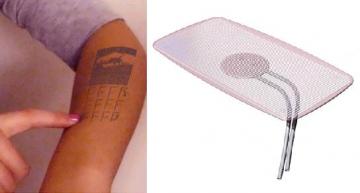
This is the kind of body-mesh with technology I like to see. I see a couple of problems with it however. While they may have solved the power problem, the saving of information is something that I don't know how they will successfully achieve until large memory storage chips that are super thin are produced. Another problem is more stylistic than functional for me. I would imagine having the tattoo on the inside of your forearm would better suit the needs of the user. Perhaps they can go with a clam shell design and have flip pads on both sides. Moreover, I wonder how this would compete with designs that incorporate the phone into the eye and ear, allowing the user to see in full color and not have to speak into their arm? It's all very Transmet though, so I love it anyway.