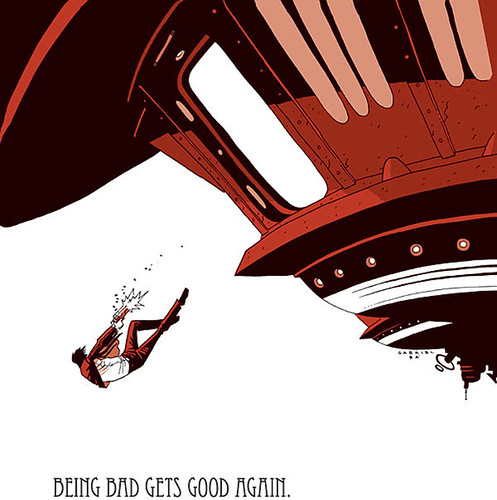
Steampunk Moves Between Two Worlds - Ruth La Ferla @ NYT
It's hard to define steampunk because much like any kind of punk, it intentionally defies definition. But some trends are apparent, much like with it's originator: cyberpunk. The ethos is based around the questions of humanity in the face of modernity and technology. While there are fashion statements to be made, the real thrust of steampunk is the idea of electric gods made human like Telsa, adventures like Charles Lindburg and dramas like the stories from the Great War. Steampunk reinvents the end of the 19th century as a time when the industrialist was also the genius of the time, when any technology was possible and society had quickly adapted to the radical shifts without much effort.
Sadly, this was not how it happened. Steampunk writers know this, hence the questions of morality and the human spirit. They are the same question we, and the cyberpunk writers, ask now. To make a tenuous historical hypothesis, I think the responses to modernity during the 19th century (a desire to return to a purer time, virulent nationalism and the rise of fascism, or at the very least it antecedents), kept the West in particular from arriving at any real answers. We are confronted with these questions again due to the rise of the Internet and all of its possibilities. The adventurers of steampunk flying airships and discovering impossible lands (Warren Ellis' Planetary should be required reading for both steam and cyberpunks) are translated into virtual adventurers moving between the physical world and the virtual with ease and where actions on one side have consequences on the other.
I do love the steampunk ethos as much as I love the ethos of cyberpunk. Both put these questions of what humanity means during times of great technological change. And both have their responses in characters that aren't quite sure of what is really happening but retain their humanity after great struggles with technology. The style, fashion and romance of both sub-genres, and now sub-cultures, are merely outward representations of these questions. However, as sub-cultures like steampunk gain wider acceptance I fear that the true punk ethos of anarchist reaction to the mainstream will lose itself in the commericalization of the culture. Just as goth, fetish and even punk its were subsumed by consumer culture, so too will steampunk fall before the needs of retail. Honestly, I believe that cyberpunk will remain the only non-commericalized sub-genre for a while due to its futuristic settings and necessary technological advances. Even so, commercialization will infect it as well.
Despite that, I don't think I will really mind such commericalization. It's inevitable in today's world. What I will mind are those who mistake the accessories of steampunk, the fashion and the attitude for the real ethos of steampunk. They, like the poser punks of the 1990s, will actually retard the progress steampunks seeks to accomplish. By ignoring the real questions steampunk poses, they will become another in a long line of fashion charactures. Yes, the fakers will come, because they have money and material desires to meet. But hopefully there will remain the writers and thinkers of steampunk and cyberpunk who look to constantly reinvent the style and shape of their genres.
Wednesday, May 07, 2008
The Commercialization of Steampunk

Tuesday, May 06, 2008
Tagging Your Laptop

Yes, it's a gimmick by a multinational corporation, but it's in response to a gimmick by another multinational corporation so it's a wash. Still, I like the cyberpunk styling of the Dell covers far more than the ultra-thin Apple laptop. It's far more personalized than the impersonal nature of Apple designs. More importantly, it puts a graffiti artist's work out in the mainstream. Perhaps it might even inspire other people to try their hand at the art form.
Monday, March 10, 2008
Knife-Fights at the Disco Party

I have this thing for jackets and other clothing like this. It's the industrial/functional look about it that makes it all so very cyberpunk. The sleek looks and minimalist design are the perfect symbol of the cyberpunk age as hidden pockets, protective armor and a sense of understated flash work together to create both an aura of 'cool' without losing functionality. This type of clothing is certainly hip without shouting it out.
Monday, March 03, 2008
Cyber Goggles Tells You Where the Guns Are
Cyber Goggles Record and Tag Your World for Future Reference - Wilson Rothman @ Gizmodo, via Miss Information
Fellow blogger and friend pointed me to this article on Gizmodo about a virtual reality interface, or cyber goggles as they are calling it, that allows the user to tag the real world in the same way information is tagged in the virtual world. It's an idea I first encountered in William Gibson's latest book Spook Country. It's an idea I adore, mostly due to its implications to the philosophy of language and the mind. When you can stop relying on your brain to recall the specific name of something what happens to your memory and language functions? What happens when language is encoded in a device that exist outside of our brains? And what does this say about the primacy of the brain in consciousness? A tagged reality is the next step towards the hyperreality simulation supplanting the real physical world. Okay, I'm started to geek out now so I'll stop here.
Tuesday, February 26, 2008
Hyperrealism, The Production of Space and Dialectic Materialism
Since I've been reading Henri Lefebrve's The Production of Space along with some minor research in the fields of hyperrealism and supermodernism, I've had to relearn the dialectical and the differences between Hegel's notion of the dialectic and Marx's dialectical imperialism. I know, I know, I should still know this but I tended to avoid anything that smacked of Marxism when I was in school. Now the off-shoots and intellectual movements sparked in response to Marxism I've been all over. Lefebrve, in writing on the production of space, is taking it from a Marxist perspective, sort of. Thus the dialectical is important. For Marx, the dialectic was the attempt to transcend the contradictions of the material world in order to attain a new height of history and human experience. Lefebrve believes this kind of attitude towards space (space meaning social space, mental space and material space) overlooks the necessity of both the distinctiveness of different kinds of space while admitting their intertwined relation.
For me, this attempt to span the contradictions of the human experience shows a misunderstanding of what the human experience really is. Camus spoke of this in The Rebel as the concepts of freedom and justice are constantly at odds with each other, neither existing without the other but without any foreseeable way of reconciling that conflict. It's a matter of not 'transcending' the contradictions of the world but allowing those contradictions to exist as is. The gap exists but it isn't a failure of philosophy. It's an acknowledgment of the limitations of the human mind. The dialectic originally meant, in the pre-Hegelian sense, a way of reasoning to arrive at a truth. Hegel and Marx turned it into some world-historical method to achieve a more perfect form of history and humanity when none was needed. Even though the dialectic has allowed us to realize the limitations of human logic it is not a system that one should take too seriously. Instead, I think the dialectic is a starting point for understanding those limitations and realizing how production in the Marxist sense is only one way to look at things. Postmodern, it may be, but it also fits within the realm of the hyperreal as attempting to expose the contradictions of the simulated reality of hyperrealism is an important task for futurists as well as philosophers.
Sunday, February 17, 2008
Eras, Ages and the Fear of the Future

At the End of an Age @ Yale University Press
John Lukacs @ Wikipedia
I bought this book a while ago on a whim and only just now have read it. More historiographical in nature, Lukacs, writing at the end of the millennium, argues that we are witnessing the end of the Modern Age. Just for a point of reference, the Modern Age is said to have begun throughout the 15th century, thus making this age five hundred years old. The purpose behind dividing the Modern Age from the medieval period that preceded it is to highlight the dramatic shift in thinking that occurred during the 15th century. Of course, this terminology of Modern and medieval mark the perspective of the book as a distinctly Western one. Lukacs acknowledges this, but considers his audience a Western one and thus does not make a convoluted attempt to fit the rest of world history into the framework of Western history.
That framework is of particular importance to Lukacs, since it is his contention that our historical consciousness is changing, just as it did at the beginning of the Modern Age. But the change Lukacs focuses on is not the mere fact of having a historical consciousness, which marked the Modern Age, but that our historical consciousness is evolving into a relative one--one that depends on taking the perspective of past historical actors and viewing their future as still undecided.
More importantly, Lukacs argues that the Modern Age is ending as we have slowly realized that the hard sciences too have a relativistic perspective. In other words, that the questions and answers of past scientists depend just as much on their historical context as they do the scientific method. Werner Heisenberg figures prominantly in Lukacs' argument as it was Heisenberg who first formulated a theory that the observer and the observed are inseperable. The Heinsenberg Uncertainty Principle was a product of recognizing that observing sub-atomic particles affects how those particles act. To put it simply, we can either know the position of a sub-atomic particle with a great certainty or we can know where the particle is going, but not both.
Leaving the science aside, Lukacs is more concerned with the metaphysical implications of Heisenberg. Lukacs' argument rests on that melding of the mental and material worlds as he believes since we cannot fully separate ourselves from our subjects for observation, we must recognize the limitations of Science to provide us with eternal truths and laws. Moreover, Lukacs argues that we must accept the primacy of the mind over matter, that while the universe may exist without us, the universe as we understand it depends on our historical consciousness and context.
I don't buy most of Lukacs' argument. I think he places too great an emphasis on the mind when arguing that the Universe is a product of our minds. For one, it reminds me too much of the Idealism of Berkeley. For another, I think it places to great a distance between the physical world and the mental world. His attempt to join the two together results more in a metaphysics of science versus a synthesis of the material and the mental. In part, I believe Lukacs' position derives too much from his Catholicism. To Lukacs, we are the center of the universe since our minds are what make up the universe. Strangely, this does avoid an anthropic view of the universe in a way. At the same time, it serves to reinforce the idea in the reader that Lukacs believes more in the Creation than in the idea of a universe springing into existence that just happens to have a planet to develop intelligent life. This idea is reaffirmed in Lukacs' position that history begins with civilization, or rather, that there is no 'pre' history.
Where I think Lukacs goes wrong is in his definition of the 20th century. He marks the beginning of the 20th century at the start of the Great War in 1914 and the end in 1989 as Communism fell. By focusing the majority of this period Lukacs ends up re-fighting the old battles between the Subjectivists and the Objectivists--a battle that I do not think needs another skirmish. But more than fighting old battles, I think Lukacs' narrow demarcation of the 20th century misses a great deal of the ideas and questions that informed the 20th century and only now are being asked again. The period of Western history from 1870 to 1945 is of greater importance to the 20th century than that of 1914-1989. While the 19th century is considered a long one, from 1789 to 1914, there are distinct sections in its intellectual history that had an immense impact on how the 20th century started. The fight between the positivist and the anti-positivists (or romantics if you like) was reaching a conclusion in the 1890s but was placed in a temporary stasis during the Great War, only to re-emerge in a slightly twisted version during the 20s and 30s.
World War II put an end to the questions of the fin-de-siécle and left Europe in a brief intellectual wilderness out of which emerged the Objectivist and Subjectivist veins of literary theory and sociological study. Part of that division in theory was based on politics. The New Left and the rise of the neo-conservative during the 50s and 60s resulted in some ridiculous intellectual battles during the 70s and 80s. It was only after the fall of Communism that the West was able to resume its questioning of what Modernity means and how morality, the mind and existence fit in with this new and rapidly changing way of life.
Unfortunately, Lukacs ignores most of this part of the West's intellectual heritage. I find it even more unfortunate considering the rise of the cyberpunk genre of literature, television and film. I do believe that we are in a transitory period, but whether that is from one age to another or simply part of a larger extension of the Modern Age I cannot say. The concern with how the mind interacts with the material world is a valid concern. Thousands of questions remain, in philosophy alone, over how the mental and the physical interact. And with the integration of the Internet into our lifestyles and the implications that brings with it will only increase the urgency of these questions. It is the existence of cyberpunk that leads me away from the conclusions of Lukacs. There is something new and different on the way, that much I can say. But what it is and how it will shape the mind of the West and the rest of the world is that big unknown, an unknown that Lukacs seems to fear.
Wednesday, January 23, 2008
Endless Horizion

This is really a topic for Ann over at femtofrosting but I just love the graphic they included. And after the spat of articles on contact lenses that might some day act as telescopes, I think it is perfectly appropriate to talk about the cultural and technological issues involved. This is cyberpunk of the last decade, but made real. For people who want a leg up on their competition or for possible future web vision directly wired into the brain, it's tech like this that will bring about those advances. I love living in the future.
Sunday, January 20, 2008
Superhuman Eyes
Electronic Contact Lenses Give Future You Crazy Eyesight, Heads-up Display - Jason Chen @ Gizmodo
Inventions like these contacts are the first serious step toward a computer-free internet interface. Beyond the mere superhuman vision capabilities, these lenses can act as head-up displays bringing you web access directly to your eye without necessitating brain surgery. Perhaps all you will need are these lenses and a Wi-fi device much like an iPhone or iPod Touch.
The next question that springs to mind is the idea of hacking into the visual display of these contacts, seeing what someone else it seeing directly. The trippiness of such an experience aside, along with the military applications, the issue of privacy does enter the equation as a skilled hacker would have the tools to "hack your eyes" to use the parlance of Ghost in the Shell. While no direct connection to the brain is required, people still look at their hands when entering information such as pin numbers and Social Security numbers. Moreover, such a hacker could insert false visual data leading to a person responding to things that aren't there.
Still, it's a fucking cool concept that should come to market. The privacy issues need dealing with, but that will come with time as well. I'm looking forward to getting my first pair when I'm fifty.
Monday, January 07, 2008
Landwarrior Come to the Civilians
Wearable Computing: The Open Wearable Computing Framework - Trendhunter
Now this what I have been waiting for; a functioning web-interface that get close to direct neural implants. Of course, I don't foresee people suddenly wearing these clunky devices but still, the effort is real and that makes me supremely happy.

Saturday, January 05, 2008
Bright Eyes Light the Way
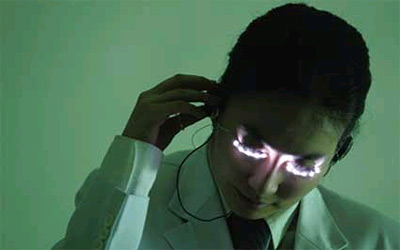
In probably my favorite posting of the day I present to you some cyberpunk fashion tech via the lovely women of Coilhouse. Ms. Lev notes the socio-political implications of the design in South Korean society as the push for biggers eyes through plastic surgery also pushed artist Soomi Park to create a design that does the very same while turning the strange 'big eye' fetish back on itself. Politics aside, I love it. This is the sort of tech I'd love to see take off in the States by the more fringe hipster crowd. Cyberpunk fashion mixed with hipster fashion could be quite interesting.
Tuesday, December 18, 2007
The Transformation of the Punk
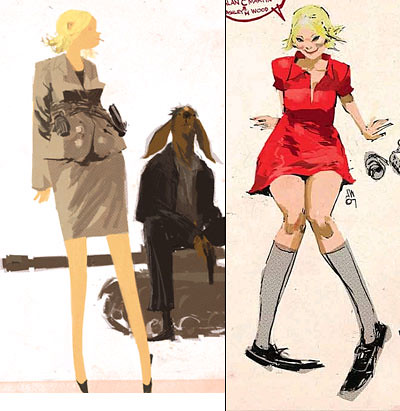
I never read the original Tank Girl. My interests in comics during that period were primarily in the X-Men realm. But she did catch my eye every once in a while and for a long time that was what a real punk was supposed to look like for me. Now, in the age of the cyberpunk, the visual expression is less important than the subverting presence of a punk mindset. Plus, I adore Ashley Wood's art, when I can figure out what the hell he's doing. Just a weird mix of nostalgia and the modern for the morning.