Bad Frame - Matt Yglesias
I think part of the problem with a withdrawal timetable for Iraq is the U.S. has never had to deal with a problem like this. The only other point in recent U.S. history where the question of withdrawal was a serious one was with the Vietnam War and even then it wasn't so much of a question of we withdraw, it was a necessity because we were losing the war. Moreover, Iraq is a different beast. Sen. Obama hasn't said that as soon as he takes office the clock on those sixteen months of his starts running. He's said that he wants the withdraw done in sixteen months. A nuanced distinction, yes, but an important one. It gives Sen. Obama time and proper access to information that will decide when the sixteen month clock starts.
I'm not going to debate the merits of a timetable since I already support it and the U.S. military simply cannot sustain itself any longer in Iraq. But I will say that reducing our numbers in Iraq will force the Iraqis to get their act together, both socially and politically, or face dissolution and civil war. It will also free up resources so the military can move against other threats. I doubt Sen. McCain sees it this way, hence my support for Sen. Obama.
Tuesday, July 15, 2008
When and How

Things One Should Not Imagine
Oh god, it's too early in the morning for this. It's all Zoectica Ebb's fault really. She's the one that suggested the idea of her and Arianna Huffington in a nude spread. It made me think for a brief moment what a male version of this would look like and then Yglesias popped into my head. Oh the hate's gettin' spread around today for that image. I think I'll punch an old lady in the neck to cheer me up.
Monday, July 14, 2008
The Opinions of 10,000 People
First it was this post over at The Dredge Report. It's a fair-handed account of the problem of cyclists versus cars versus pedestrians. This led me to a post over at Manifest Density that tacts a bit against cars in favor of cyclists. The trail goes on from there to a post by Andrew Beaujon over at the Washington City Paper that points to a site listing photos of cars violating cyclist lanes in D.C. Beaujon returns to a more olive-branch approach by calling on cyclists not to complain only about cars but about other cyclists violating traffic laws. He links to another posting by Matt Yglesias, who moves back toward a pro-cyclist position. The link-path stops there along with the addition of two separate posts by Megan McArdle who takes a no-prisoners approach to the cyclist/pedestrian versus car war.
The first thing I notice about all of these posts are that they focus on Washington D.C. primarily while making the obligatory nods to cities like Portland, Boston, NYC and San Francisco. The second and more important thing I notice is that it appears as if few of these bloggers have lived in a city where a car is the primary means of transportation. With the known exception of Adrock over at the Dredge Report, it's as if driving a car were a foreign concept to this menagere of bloggers. In their eyes, the car is the problem while the pedestrian/cyclist is less at fault based almost entirely on the idea that the cyclist/pedestrian has more to lose (their life, say) than a driver in a car if an accident occurs.
I can agree with that position. It's entirely sensible. And drivers should have a greater appreciation of patience and awareness as they drive. Now here comes the 'but'. I live in Dallas. We once had street cars and such up until the 1960s when the city council made the huge error of favoring buses over rail and cutting rail service. As a close friend of mine can attest, taking the bus is not a viable option for many since it usually add another hour to one's commute, if you make the right bus. Only now has the city moved back to favoring light rails as a mean of reducing congestion. Still, building a functioning rail network in an urban space not designed for rails is long and difficult work. The planning and financing alone is enough to table almost any rail proposal.
That all said, the denser areas of Dallas have slowly realized the advantages of walking and biking. Unfortunately urban Dallasites have yet to learn cyclist traffic laws. Plus, there's a glaring example in the middle of the wealther part of the city that puts most of these pro-cyclist arguments in a rather sticky position. The city intentionally built a walking/cycling trail called they Katy Trail as a way of greening the city. Sadly, there are a few places where this trail crosses streets with deadly deadly cars on them. My experience with the trail commonly comes at a heavily trafficked street called Knox. I don't mind the trail cross streets, even major ones. But I will feel no sympathy at all for the pedestrian or cyclist who comes flying across the hood of my car, not even if they die as a result of their injuries.
Let me explain, if you will. About a hundred feet to the west of the trail is a T-intersection where Knox ends. Coming from the east toward this intersection is a single-side speed bump. In addition, the trail itself is raise above the street level; acting as a speed bump in its own right. A lot of traffic comes through this point, particularly at rush hour when I usually drive through. So, to make it clear, there's not much room for a car to reach more than 20mph and even then you have to slow down for the trail's speed bump.
So, here's the problem and the reason why I lack sympathy for pedestrians or cyclists who get injured or killed at this intersection of trail and street. On both the north and south point of the trail there is a stop sign. No sign exists in the direction the street moves in. I have nearly clipped three cyclists, a mother with a baby carrage and two walkers crossing this intersection. Why have these near-accidents almost occured? Because every person I've seen on the trail crossing that intersection has ignored the stop sign. This blithe ignorance of a stop sign when cars, SUVs and heavier vehicles cross this part of the trail is just plain stupidity. It's not as if these vehicles are screaming through the intersection; they can't by both design and circumstance. And yet the walkers and cyclists continue to glide right through.
I'm not against an urban area becoming more favorable to pedestrians and cyclists. In point of fact, I'm all for it since it reduces congestion while making people healthier. I'd love to see a white-bicycle program in the center of Dallas. That said, I shrug my shoulders at an instance where cars are clearly given the right of way and are consistantly stopped by people violating a traffic law. It's the same as if a pedestrian stepped out from inbetween parked cars into a street and has their brainless ass thrown forty feet in another direction by the driver who never even had the chance to hit the brakes. Actually, it's less like this since the pedestrian/cyclist can see the cars coming well before the drivers can. And ignorance of a law is no defense against violating it. Thusly, not only will I yell at the person or cyclist who either hits me or I hit them, I'll make them pay for the damages to my car. Everything the city can do to protect the pedestrians and cyclists on that trail from colliding with a car has been done. It's only by virtue of a driver's fear of hitting a person do the pedestrians and cyclists continue to cross this intersection injury-free. If and when someone does have their law-breaking ass landed on the hood of an SUV then perhaps the pedestrians and cyclists will start paying attention and taking some personal responsibility for how they cross that intersection.
All of the following rant isn't my full position on how cars, pedestrians and cyclists can get along. Rather, it's a useful example of how the supposed ignorant drivers actually do pay attention to those on foot or bike while just the opposite occurs with the cyclists and pedestrians. Moreover, it's a consistant and continuing problem. Yes, the city will need to make changes to city streets to further protect pedestrians and cyclists, but not in this case. And this all comes back to the first thing I noticed about the liteny of bloggers complaining about ignorant drivers. You already live in cities incredibly favorable to cyclists and pedestrians. Try the shit you do in D.C. in Dallas and you're liable to end up pulling bits of chrome grille out of your body.
So I have a question I'd like to pose to those who live in cities with decent public transport, cycling paths and lenient pedestrian laws: what would you have a car-centric city like Dallas do to make itself friendlier to those who would rather walk or bike than drive?
Supermodern Music
Review: Ratatat "LP3" - Nate Patrin @ Pitchfork
I'm not reviewing Ratatat's new album so much as I'm taking an element of Patrin's review and fleshing it out. Patrin spends much of his time discussing the acontextual nature of Ratatat's sound. It's an interesting point to make about contemporary music. Describing the sound as lacking content, Patrin argues that Ratatat could "sound like anything but no one discernable identity" and then immediately states "Ratatat's music is only really as empty as you make it." The argument is strange in the sense that it claims the listener/producer/marketer has as much a role in defining the sound as the band does. What I think Patrin is arguing is that Ratatat has hit on supermodern music.
The very idea of applying the framework of supermodernity to music hadn't occured to me before. Yet it works. Supermodernity is in it's nascent stages of definition. The term derives from contemporary architeture that creates space to move through rather that spaces to live in. It's archtecture ripped free of context which paradoxically allows for anyone to assign a meaning to it. Placing music in the realm of the supermodern thus means the sound of Ratatat is contextless making it applicable in a multitude of situations. It's not so much 'furniture music' as the early 20th century pianist Erik Satie strove for and found it's place in IDM electronica. Rather, it's music that can produce a meaning, but one that exist only in relation to other forms of information.
I love the idea and Ratatat's music is interesting to me in its own right. There is the potential for supermodern music that isn't even interesting. Even so, that contemporary music has reached a point where one can reasonably call it supermodern is extraordinary. It entails a whole new genre that can encompass nearly any style of music while remaining context-free. What's more, I doubt many people will realize it at first; even the music critics might miss it if the music comes in a radically different form. Yet Ratatat has done it. From the few tracks I've listened to the music stands on its own without falling into the trap of 'wallpaper music'. I think it's worth a listening, if not a purchase.
Thursday, July 10, 2008
Troubles from a Jeweler's Bench
You know, trying to find a direct conversion of millimeters to carat weight is hard to find. Now I'll have to pull the stone out of it's setting. Oh well, it was a little wonky in there in the first place. Just more work for a damned appraisal.
Wednesday, July 09, 2008
A Day Late But Fuck Your Short Dollars

Now, the new song itself is drastically different than previous efforts (I would say radically if it wasn't for the use of looped bits and electronic noise on a few tracks from their last album). Even so, "Mercury" is a great song and a logical direction for the band's sound coming off A Weekend In The City. The heavy use of key bass, 808 drum beats, quick-cut vocals and symphonic backing along with noise art loops and LCD Soundsystem-style claves and other hand percussion instruments form the core of the track's sound. Layered over these new elements are Matt Tongs complex drumming and Gordon Moakes thunking bass lines. Conspicuously missing is Russell Lissack's distinctive guitar work with the only occasional guitar riff making a subdued appearance. Lead singer Kele Okereke's lyrics speak of smoothness and predictable actions which contrasts with the stop-start structure of the song. The music's chopped-up sound points to the chaotic undercurrent of reality while Kele sings of things that are meant to give that chaos the appearance of a continuous narrative.
The seperation between what "Mercury" has to offer and Bloc Party's previous efforts is comparable to Radiohead's transition from The Bends to Ok Computer. This is not to say that Bloc Party is as innovative as Radiohead, but merely to mark the distance between A Weekend In The City and the sound "Mercury" represents. I doubt mainstream fans of the band will like the new sound but personally I love it. I think it's a good direction for the band to take in an era of music defined by the mix of electronica and rock music. More importantly, after two albums so guitar-laden and 90s influenced, the band needs some new tricks to avoid producing a stale rehash of their previous albums. Bloc Party had a distinctive sound when they first came on the scene and if "Mercury" is an indication they will continue to strive for distinctiveness. If the new album is truly their 'experimental' album then it's the right step for a band that avoided a serious sophmore slump with their second album. They have some room to play around now and are willing to take the risk of losing some older fans for the sake of uniqueness. It's a great track and I hope it earns some good critical reviews.
Monday, July 07, 2008
A Correction: History Gone Wrong
In commenting on a Coilhouse post on men's fashion taking on a more dandy look, I defined the time period as the Victorian Age. Naturally, my PhD in Victorian Literature-holding sister had to correct me on this. So without further ado her is her explanation for where I went wrong:
Jordan,Uh, Brummell isn't a Victorian, technically speaking. Brummell belongs to the Georgian period when morals were loser and a multitude of undesirable behavior was buried underneath the properly tied cravat. Read Jane Austen for an idea of Brummell's time. And no, Jane Austen isn't as straightlaced as you might think. In fact, she deals quite a bit with the rake figure Brummell so embodied if not the ton that he inhabited. (The elite classes in the Georgian period actually named themselves the ton or the world. Silly elites.) At any rate, for a good overview, read Linda Colley's Britons, the new biography on Brummell I have floating around, and Ellen Moer's book on the dandy. The reason the age distinction is important is because the advance in men's fashion heralded by Brummell happened at a gallop. It didn't evolve overly much afterwards, except to move from breeches to actual trousers. Women's fashion, on the other hand, changed rapidly, not quite catching up to the simplicity of the Brummell revolution until the Edwardian age and the 1920s/30s sport look.
Modern Music is Rubbish
At the moment I'm listening to a cover of Feist's 1234 by a little electro-duo called Bikini. Their back catalog consists of one 7" single with the A side being the previously mentioned cover and an original song of their own as the B side. This was released perhaps a month or two ago before hitting the interweb music blogs big, making it all the way onto elbo.ws top ten hot tracks. These days when I'm looking for new music elbo.ws is one of my first stops as it's a music blog aggregator. Finding complete mp3s of a song is essential to discovering new acts and determining whether to invest your time and, sometimes, your money in. This is the way modern music is disseminated to the discerning masses.
Before I went to sleep the night before, Miss Information at fotophonic emailed me a snippet of an interview with Doug Marscht of Built to Spill. The interview, conducted by Michael Saba at Paste Magazine is rather short; just a brief catching up with the band and asking Marscht about the Perfect From Now On tour and the upcoming album of theirs. On the whole, the article isn't all that interesting except for that one snippet Miss Info sent me. The question is standard when interviewing such a seminal figure as Marscht who had such a defining influence on music during the 90s and on into the early 00s.
Paste: What’s your take on modern alternative rock, especially because you’ve said before on numerous occasions that you’re not too hot on a lot of it? Is there anything you’ve heard or seen recently that you’re impressed by, or do you just tend to ignore newer music?I'm of two minds about Marscht's view on modern music. On the one hand, I can understand Marscht's position as he's been recording and playing shows since his Farm Days and Treepeople days going all the way back to the early 1980s. When you have played for that long with so many bands (Built to Spill being the primary band of Marscht's) it's hard to say that you find modern, or rather, contemporary music influential in any significant way. So Marscht's position is eminently justifiable; and at this point I would find it a shame if Marscht were to alter his style to reflect modern music. He has settled on a kind of sound that would suffer greatly if influenced by modern music. Marscht has developed his sound over the years, but to suit the sounds in his head more than the sounds of other bands.
Martsch: I mostly just tend to ignore it. Not at all because there’s not good things going on, I don’t know why, I’m just not interested. You know, I’ve answered this question several times, and sometimes I’ll say the same thing, sometimes I’ll make shit up. Not on purpose, but just trying to understand it myself. I think what makes the most sense to me is that part of music is learning about the world, and learning about things, the same way that movies and books and TV and things like that help people learn about the world. When you’re young, you’re a sponge, and you can listen to things and learn a lot about the world. And I feel, myself, that there’s not a whole lot I can learn from some 25-year-old from America. Or the things that I could learn would be pop-cultural. But at the same time, you know, like the Arcade Fire– I thought that first record of theirs was really great. I didn’t learn anything, but it was great music. I never consciously, when I was young, thought I was learning things from music. As I got older, I guess I thought that might be the reason.
On the other hand, I find Marscht's seeming disdain for modern music disconcerting. It's not so much that Marscht has rejected modern music but his opinion of it as something he can't learn anything from is a touch myopic. Music is pop cultural, as much as any book, movie, blog or TV show is. You can't completely isolate yourself from the world of representation as it is a continuous process that, by merely existing and observing, participate in. New additions to our cultural milieu naturally alter our perceptions of the world-even if only in minor ways. It's a cycle that you continually add to whether artist or not.
Theory aside however, I think Marscht is still missing the point about the question Saba asked. It's not so much asking Marscht if he will alter his sound to reflect modern music but if modern music has an effect on how he perceives his music and production values. This last point is key to the change in modern music and something that Marscht himself points to as an asset in his latest recordings. The use of modern technology to improve the way a new song is produced is as much learning from modern music as altering the style of music you play. Production values have long been a keystone for music since the 60s when recording went from 4-track to 8-track and beyond. Moreover, the rise of rap as the predominate form of music on the radio has led to a change in how bass and drums are featured on any particular track. Rock music from even a decade ago doesn't pay as much attention to those elements as they do now.
Finally, the music styles of today pull as much from the past as they do from outside genres. The melding of electronica with modern rock styles has reshaped song structures, instrumentation and the range of styles a single band can play without appearing to rip off another band. I'll give you that a lot of the music is derivative; either directly from the 60s and 70s or from popular contemporary acts. Despite that, many other bands have begun to take their influences and incorporate them into a sound the band finds pleasing without wearing their influences on their sleeves. Bloc Party is an excellent example of a band that has drawn on song structures found in music from the late 70s and early 80s like Gang of Four, Joy Division, and The Smiths while using instrument styles found in the music of 90s bands like Smashing Pumpkins, Radiohead and Blur.
Beyond such highly popular acts as Bloc Party are the garage punk and disco punk bands who appeared on the scene in the early 00s. While they were not the first to take on disco and garage music since the 60s and 70s, the pop sensibilities of some bands like The Strokes, Black Rebel Motorcycle Club and The White Stripes brought them to mainstream attention. That popularity, while quickly disappearing from the mainstream, was continue on Interwibble and its ever-growing collection of music blogs dedicated to hunting down the next great band. Liars, LCD Soundsystem, The Klaxons and several other bands interested in the use of electronic elements in their music were quickly snatched up by the music blogs and spread far and wide. Moreover, the technological advances of more powerful home computers along with recording and production applications on par with those found in expensive studios have allowed bands (a term becoming more loosely applied as the need for the traditional four-person set up has fallen by the wayside) to record and craft their music at home and release the digital recording to the swarms of music blogs. Even the technology available for live music has advanced to such a degree that two-person acts like The Dodos, Fuck Buttons and The Kills are able to play without needing touring musicians.
All of this goes to say that Marscht's opinion that modern music has become more about image than music is an axiom and almost hypocritical. Mainstream music has always focused more on image than music. And the big but non-commerical acts like Bloc Party and Interpol put on shows where the audience is there more out of maintaing their image than to listen to the music. Their still is a group of people who attend shows out of a real desire to listen to the band without concern whether the hip people will show up or not. The Interweb has allowed those true listeners to know when and where to see the bands that speak to them. And those people will learn something about how modern music is played and the potential directions it can take. While I don't think Marscht should suddenly start playing tight riffs backed by a disco beat, I think his opinions on modern music reflect the attitude of someone who doesn't want to learn anything from modern music. And that's fine, especially since Built to Spill continues to put out quality music. But it still is a limited view of things and one that can have a negative impact on those influenced by Marscht and Built to Spill.
Sunday, July 06, 2008
Supercar Goodness Turbocharged

Had I heard an auto-maker like Chevy or Ford were attempting to add turbochargers to their engines I would scoff at the idea. While they do take pride in their high-end cars, producing a proper turbocharger requires some serious design changes and the use of special components either cast to higher strengths or high-quality hoses. When I originally looked at the Audi A4 I easily made the decision to go with the smaller 1.8l engine versus the larger 3.0l. For one, the 1.8l was turbocharged and for another, the weight of the engine, turbo and all, was much lighter than an engine nearly twice the size. The advantage of a turbocharger is rather simple to understand. Only under hard acceleration does the turbo kick in and then only when you reach a high enough rpm. In other words, a turbo does not constantly run, and even under acceleration, does not always run. So you gain in fuel economy while keeping a reserve of power when needed.
If Ferrari is serious about adding a turbocharger to one of their engine models then they will do it right. The parts will all come highly strengthened but done so with minimal weight. The air flow from the turbo to the engine will have as few restrictions as possible as will the air flow into the turbo itself. Yes, when the turbo kicks in, the onboard computer must increase the fuel flow lest the engine run too lean. But the proper calibration of injectors, airflow and computer will minimize the increase in fuel consumption during the forced induction of the turbocharger.
For those of us with lower end cars like the A4 we have to make do with the turbo as is or do some serious modifications to enhance the total airflow of the engine. Of course, by improving the airflow we gain in fuel economy while enhancing overall performance. Unfortunately, we don't get the smoothness of a six cylinder engine (V6's tend to run the smoothest due to the way the cylinders are timed with two down, two up and two in the middle). Still, the smaller engine does help a lot with fuel economy while leaving room for improvement.
This news does support a claim of mine I made against Matt Yglesias and his de facto support of limiting horsepower. If an auto-maker like Ferrari is considering using smaller turbocharged engines to maintain their high horsepower then it goes to show that revamping an engine design to take advantage of forced induction while making the engine smaller is another route auto-makers can take to keep their horsepower other than artificial limits on horsepower. It also shows the power of the market as Ferrari is reacting to the high cost of fuel by looking at more efficient engine designs.
The Perils of the Audiodive
Coming out of audiodive. Ears should return to normal by morning. So much good stuff to throw out there. Head's too wrapped up and stuffed with cotton to sort it out for posting tonight. At least I was able to spend an ungodly amount of money on my car today.
Saturday, July 05, 2008
Reality Torpedoes - Updated
The Difference - Matt Yglesias
I didn't want to read another Charles Krauthammer op-ed on Sen. Obama's supposed cynicism, I really didn't. I feel quite cheated afterwards, as I've said before. And the fact that Krauthammer is shocked, shocked I tell you, at a politician repositioning themselves for an election is depressingly hilarious. John Scalzi gets it. I get it. Obviously Yglesias gets it. Why can't Krauthammer get it? Is it because Sen. Obama is black or because Sen. Obama is a Democrat? Or is it because Sen. Obama does not dogmatically follow an agenda, damn the reality torpedoes. These attempts to hang the sign of 'flipflopper' on Sen. Obama don't really work when throwing everything at him at once. You end up with a confused, contradictory attack. Krauthammer wants a continued presence in Iraq so shouldn't he hail Sen. Obama's flipflopping?
Update:
It seems Andrew Sullivan has joined the growing chorus of people tired of Krauthammer's meanderings on Sen. Obama's shifts since he became the presumptive Democratic nominee. It isn't hard to get both that Sen. Obama is a politician and a change in tactics is not a change in strategy.
The Firebadger is set to Stun
Firefox grabs bigger slice of browser pie - Egan Orion @ L'Inq
I've used Firefox for years now; since it's days in pre 1.0 release. The slow conversion of the rest of my family was successful. And I tout the benefits of Firefox whenever I can. It's simply the better browser at the moment. More to the point, the decline of IE users means websites (at least the good ones) have started using open standards in the coding of their sites. Even though I still use WindowsXP for my OS, I try to use as many open source apps as I can find. Not because I believe in the big bad of Microsoft anymore, but because keeping the code open for people to review and change at will means bugs and security problems tend to get fixed much faster than in closed source systems. Now if only game makers would recognize the need to make their games portable to Linux then I wouldn't have a need for Windows at all.
Friday, July 04, 2008
Can't Find a Better Man
Ex-Senator Jesse Helms dies at 86 - BBC News
I would say something kind about Sen. Helms and how his death represents an end of an era, but considering a better man got shot this week and lived, I'll just say I hope Helms burns in hell for a good while.
And yes, I know I used Pearl Jam for the post title. Just remember, I'll stab you if you give me shit about it.
Thursday, July 03, 2008
A Gentleman's Attire

I suppose the most accurate comparison to the dandy of the Victorian Age is the metrosexual of ours. Fashionable men dressed in elegant clothing with the occasional excess is the most common form seen. What Brummell did was take that excess to an extreme for the dandy. Lev's article points to a contemporary example of such excess of the dandy form complete with serious corset usage and high collars. It's not my taste really, but I do love seeing this kind of brilliance in men's fashion make a return. I doubt you'll see many men actually dressed like this, in the same way that you won't see many of the original dressed designed for runway models worn by everyday women. Even so, the derivatives are what's important. Elements of the dandy will find their way into men's fashion over a period of time with certain looks becoming the standard. I don't think people appreciate what a true gentleman has to do in order to maintain a well-groomed appearance without looking over the top.
Courtesy of Fritz Lang

No wonder my copy of Metropolis made no sense. I thought it was just a quirk of the movie. Plus, I was too lazy to do any research on it. But now this means I get to buy a brand new edition with all the extra greatness. Tis a good day.
I'll Spit Live Rounds That'll Penetrate a Fast Nigga
Brian Beutler - Matt Yglesias
Bullets Can't Stop Me From Cracking Wise - Adele M. Stan
Brian - Ezra Klein
Crime Doesn't Pay - Megan McArdle
So apparently you haven't made it in D.C. progressive blogger circles until you've gotten shot. Fortunately, Mr. Beutler will make a full recovery as they say; i.e. live. At least this wasn't like Tupac, because somehow we'd see his writing increase. Best of wishes and all that. Oh, and Adrienne, what was that about how great D.C. is to live in?
Damn Your Eyes!
One last thing before I curl up with my signed copy of Heads in the Sand and my happy little Klonopin pill: if you haven't been reading my friend's blog The Dredge Report then I'm afraid I'll have to cut your Achilles tendons.
Wednesday, July 02, 2008
Running Up The Score Is Soooo Unfair

I have to say, Scalzi makes some great points here, but the fifth and last one is the strongest rebuttal to the far left's disdain for Sen. Obama's current centrism. I just have to directly quote Scalzi because anything less would do an injustice to Scalzi's words:
Obama’s probably also aware that he’s got the left in the tank. Some folks on the left were goofy enough in 2000 to think that voting for, say, Nader, wouldn’t make a huge difference in the end, so why not make a cute little protest vote. Here in 2008, anyone on the left who isn’t planning to pull a lever for Obama probably has congenital brain damage.Scalzi is absolutely correct on this point. Sen. Obama is a politician and apparently knows both strategic planning and tactical maneuvering (unlike, say, President Bush). So while he does make some of the best, most inspiring political speeches of this generation, he also knows that politics is a game where bitchslapping your opponent early and often works. Taking positions on issues that appeal to a wider range of voters, tacitly supporting legislation that's unlikely to pass and appearing to cater to the expected base of your opponent when you have the chance is smart politics. No, it's not the Politics of Sen. Obama's speeches, but it is the politics that he has to engage in. Had he not, Sen. Obama wouldn't exist; not even State Sen. Obama. So, politely to the left, suck it up.
That's Right! That's Right! Oh, That Ain't Right.
And It Wouldn't Be The First Time, Either - John Scalzi @ Whatever
I get to experience the weird duality of a cat on your chest. Most nights now usually end with the last light turned out, me sliding down in the covers and my cat, Marie, hoping up on my chest to nuzzle my face. Of course, for every five units of adorable nuzzling is one unit of cat ass in the face. Why? I really don't know but remain deeply disturbed by it. Sometimes I've woken up to such nuzzling, but I fear for the morning I wake up to cat ass.
Existence as Stress
Severe Shyness? New Study Shows That Anxiety Is Likely A Long-Lasting Trait - Science Daily
Son...of...a...bitch. I hate my genes and would like to stab every strand of my DNA in the eye.
A Case of the Vapors

I'll believe it when I see it; otherwise it's just vaporware.
Fraternity Hazing
Christopher Hitchens waterboards himself - Cory Doctorow @ BoingBoing
Well it's nice to know that there's at least one political pundit willing to put his money where his mouth is.
Horsepower = ?
Horsepower Controls - Matt Yglesias
Being something of a gearhead I've taken a long look at things like horsepower and torque while wondering how the changes I make to my car will affect my fuel economy. Then again, I have a relatively small 1.8l turbocharged engine that in stock form had an average fuel economy of 22/28 city to highway mileage on 170hp. After replacing the air intake with a cold air intake I ended up with around 180hp but a fuel economy of 25/30. This is one area where horsepower was not the point but increasing the amount of cold air entering the engine was as it dramatically improved the running of the car without making it smaller or limiting the horsepower.
Focusing purely on horsepower is fairly ridiculous if you wanted to make an argument for more efficient cars. The argument you want to make instead is to point out all of the inefficiencies that exist in stock configurations. The tuning crowd is just as obsessed about weight reduction as they are about increased horsepower. Open your hood sometime and mind the effort it takes to lift the hood even with the help of a hydraulic piston.
A more fuel efficient car comes not just from limiting horsepower but from making the car as light as possible without losing the necessary structural rigidity. Carbon fiber hoods, lightened alloy wheels, lightweight aluminum flywheels, carbon fiber drive shafts, and metal sections cut up like swiss cheese are all common things on a tuner's vehicle. It's basic physics--the lighter the car, the less energy you need to get the car moving. Shedding twenty pounds here and fifteen there seems like ridiculous obsessiveness but when the pounds add up to the weight of an average-sized person then you realize how important weight reduction is in improving the efficiency of a car.
The reason why average horsepower has gone up in the last thirty years is not solely because of American desires for speed but because the amount of power it takes to move a three or four ton SUV around. Horsepower does not directly translate into speed. The three-ton pick-up truck that passes you on the highway may have a big V-8 with 300hp but anything less and you would have a vehicle that struggles to maintain highway speeds. Meanwhile, the little Mini Cooper that zips past you has a tiny engine but it doesn't need anything more to produce that kind of speed.
The point is Yglesias is wrong to assume that limiting horsepower alone would bring about some sudden leap in fuel economy. Certainly a smaller engine would do that but put a small engine in a heavy car and you will still have terrible gas mileage. What Yglesias should really argue for is a complete rethink in car design with an emphasis on improving the efficiency of the engine while making the car as light as comfortably possible. This means using more expensive parts and removing restrictions in the air flow into the engine. Oh, and there's one more way to lighten a car that few people think of--go on a diet. Losing twenty pounds on yourself can have the same effect as losing twenty pounds on the car. That engine has to lug your ass around so why not ease it's burden?
Ending Cute Naiveté
There's a young lady whose father has been a customer of ours for some years now. She apparently has taken several courses in jewelry design and such, and now it seems that her dad would like to see some payoff of the money spent on said courses. She's coming to my dad's workshop at home to spend some time casting and making molds--general parts of jewelry design naturally. I, on the other hand, want her to come work at the store for a couple of days a week. The reason is simple; I want her to understand what conditions jewelry is placed under in everyday circumstances. More to the point, I want her to know the stresses certain metals and stones can take before breaking and then what to do to repair the items. I want her to know what frosting a diamond is like, what happens when you heat an opal too much and what a diamond magnet does (key tip here, diamond magnets don't exist). She needs to know these things if she is going to go off and become some great name in jewelry design because she becomes responsible for the piece from the time she makes it to the time it comes back with a broken prong, a missing stone or a cracked shank. It's time for her to have a jewelry drill sergeant and my grandfather and I are perfect for the job. We don't half-ass our way through a custom piece or a simple repair. And that's what I want to teach her.
Become Your Own Electric God
Power Awareness Quiz - Kevin Kelly @ The Technium
This is actually a timely piece for me as I was looking up different residential energy generators last night. While a lot of solar power is still prohibitively expensive (particularly solar shingles resistant to hail damage) there are other products out there that could make an impact on your monthly power bill if managed properly. Vertical wind turbines are of keen interest for me since their design gives them a low profile while maintaining the energy generating power of much larger propeller designs. The key thing is not necessarily to convert your entire house into an electrically self-sustaining abode but merely knocking away a lot of the regular power usage so when you reach a peak usage it is barely reflected in your monthly utilities statement. A mix of solar cells and wind turbines, which produce little power but do so in a nearly continuous way, could easily handle the lighting in your house. It's just a matter of finding out what you can afford and what permits and instillations costs are. After that, you can just keep adding on new panels or turbines as you like. While the initial investment is large, the return on that investment is actually relatively short--anywhere from six to fifteen years so I've read. My parents have lived in the same house for over twenty years and my grandparents for more than fifty. So it is feasible, but figuring it out is a touch difficult.
Cracks in the Fourth Wall

And a little more of our world is taken over by Morrison and Ellis.
Sticks and Stones v. Sharp Darts and Razor-Blade Tongues
A friend of mine asked why I closed the comments section on my blog (particularly since I get so low traffic that it's really unnecessary) and my only response was once there were enough people wanting to comment then I would reopen the comment section. Now I've argued before about the dangers of reading message boards and some of the insanely stupid things said there. I've also argued that it's the right of whoever run the board or blog to moderate comments however they wish. I like as much transparency as possible as it tends to engender better discussions. Yet, in the same day I've read two posts from mid-level to major blogs that tackle their own problems with comments and perceived censorship.
The first came from BoingBoing concerning their removal of several post related to a particular blogger. As they rightfully argued, it is their site to run and they hold the ultimate decision over what content appears on their site, particularly when that content derives from outside sources they have no control over. To remove a selection of posts, for whatever reason, that were not original works by the people at BoingBoing is not an attempt to silence or censor the original creator. The fact is, those posts still exist, whether on the original author's site or in places like Google Cache. It's not an act of censorship to remove posts that run contrary to the ethos of a blog, particularly one as well-read as BoingBoing. If they no longer want their name, and the legitimacy it brings, associated with a certain blogger then that is entirely within their rights.
The next post comes from Obsidian Wings and their reworked posting policy. To quote from part of the new rules:
We have no desire to censor people whose views we disagree with. However, there is a difference between stating and defending an unpopular position on the one hand, and repeated drive-by insults on the other, and the fact that we welcome the first does not mean that we must accept the second.In other words, the people at Obsidian Wings have staked out a position against trolls and other types of commentators who offer nothing to the discussion but persist in attempting to derail the conversation. Simple name calling does not count as honest participation in my opinion and is the primary reason why I avoid message boards and comment sections. I can get enough of that in the letters to the editor section of my morning paper.
The idea, as hilzoy from Obsidian Wings states, is not to prevent people from saying what is on their minds but to end nonsense postings that lack an argument or point. Most well run message boards and comment sections have similar policies because, well, there are just some stupid people out there who thoughtlessly spout off.
It's a balancing act really between maintaining the ideal of free speech and the ideal of civil conversation. Civil discourse cannot exist without free speech but free speech does not mean an anarchy of speech. Honest moderators will rarely pull the plug on someone, but as with the Violet Blue problem on BoingBoing, the ability to do so is necessary to maintain the point of free and civil speech. It's not an easy problem and is one that should remain on the forefront of any moderator, poster or even mere reader of a message board or blog.
Tuesday, July 01, 2008
Cloud Theory

This is a wildly interesting article on the rise of petabyte levels of data can lead to a way of making predicable observations without an overarching theory or model. Kelly argues that such methods already exist and are employed by search engines like Google or the mass of data coming from radio telescope observations. What Kelly argues is that with a large enough data set one can develop a method of determining the probable outcome of an event as gathered from certain consistencies within the mass data. Pivoting off another article by Chris Anderson at Wired, Kelly points to the use of correlative data as the means by which Google is able to create highly competent translations of works written in different languages without the need for human translators or a model of translation. Simply gather enough data points and you can write an algorithm that produces such roughly accurate translations.
What both Kelly and Anderson argue is with enough data, an a priori hypothesis or a postiori theory is not necessary to make accurate predictions. And as both point out, such an argument radically changes the way we can learn in nearly any field. Where Kelly and Anderson diverge is over whether this argument means the end of theory or simply a change in how theories and models are created.
One point against this argument is W.V.O. Quine's indeterminacy of translation argument. In essence, Quine argues that the range of meaning in an unknown language is large enough that errors in translation are a given. Within a set of data points there might exist certain points of data that when added to the set break the existing model of explanation. We've already seen such a break occur between Newtonian physics and Einsteinian physics. Newton's theory of motion, while still useful in the everyday sense, cannot explain the new data points added since the development of his theory. Einstein was able to offer a new model that did explain both the old data set as well as the new data points.
Quine's indeterminacy theory, much like Heidegger's argument against the 'clearing of all clearings' means that no matter how good a model we construct new data points that the model cannot explain are always possible.
I have to say I have mixed feelings on the idea of predictable observations without an explanatory model. Certainly no model is perfect and one should always place primacy on evidence over theory. Yet, I agree with Kelly that Anderson goes too far with his thesis that cloud data is enough to end the need for theory. Kelly believes that we simply are reaching the limits of human logic and conception. I believe that we are finally reaching the end of our mental childhood. It's only been a little over eighty-years since Heisenberg introduced the uncertainty principle into quantum mechanics. Add to this the wave/particle duality of light, quantum superpositions, and the infinitely brief existence of virtual particles and you have a collection of ideas, thought experiments and theories that are highly difficult to understand but are understandable. So Kelly's assertion that we've arrivied at the end of human conception means, I believe, that we simply have to stretch human conception further.
Just You Wait, Mr. Boomer, Just You Wait
What Did Vietnam Teach John McCain? - TNR Staff @ The Plank
And thusly is Rogers point proven.
Qualifying Shrapnel
Last Dance, Last Chance for Loooove - John Rogers
I hadn't wanted to wade into the waters of the Wes Clark non-story but Rogers take regularly tacks differently than others; mostly to his advantage but not always. After quickly running through the general truth of Clark's dumb remark (military service isn't a sufficient quality on its own to make oneself proficient in foreign and military affairs. I think FDR pretty much nailed that one), Rogers then puts forth the interesting, yet obvious now that you see it, idea that the uproar over Clark's remark isn't about its truthfulness but about the continuing psychodrama Vietnam plays in the minds of baby boomers. I truly do believe that this presidential election is the last one that will depend heavily on boomer issues and perspectives. And not a moment too soon in my mind.
The new century has a new electorate as well, one with a distinctly different set of issues facing it and a different perspective on how to deal with those issues. The baby boomers will still play a role, but they will not hold the levers of power for much longer. Whether this shift will benefit the nation or not is too early to tell. It will differ from the past though, and not always to the boomers liking. Once Vietnam and the 60s leave the collective consciousness of the electorate I think we will see a serious change in priorities and how we faces those challenges. But statements like Clark's will become nothing more than dusty reminders of a past mindset we don't want to go back to. That's Rogers' point and where he gets it while others don't.
30 Seconds to Funny
Google, Family Guy creator to shake up video distribution - David Chartier @ Ars Technica
This is either potential genius or disaster. Even so, it's gutsy and I'm eager to see if and how it works.
Saturday, June 28, 2008
The Ghost of Gustave Le Bon
"Wisdom of Crowds" Works For Individuals Too - Slashdot
Back at the beginning of the 20th century a French sociologist gained fame through his research on crowd behavior and what he called the 'crowd mind'. The sociologist was one Gustave Le Bon and his conclusions where that the crowd mind was a far more simplistic and persuadable entity than that of the individual. Oh, and he had a serious authoritarian streak in him which led to his writing on the necessary qualities of a truly powerful leader. In other words, the linked article above is bullshit of the worst kind. It mistakes the distributed minds of open source coders, Wikipedia users and the social networking types for the crowd mind. They are distinct entities and such a mistake is factually costly. At the risk of invoking Godwin's law on this post, I do have to mention that both Mussolini and Hitler, along with their attendant 'intellectuals', were highly influenced by Le Bon. The man is considered a proto-fascist intellectual in that he helped build the intellecutal foundation on which fascism based itself. So be careful when you see articles like this one and make sure the authors aren't getting the crowd mind confused with the distributed mind.
Renaissance: A Review
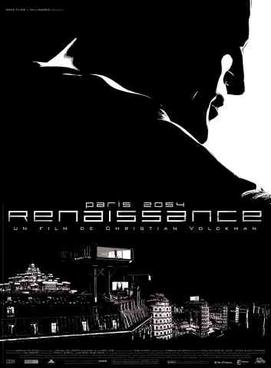
Beyond the plot and the character development is the way the movie was filmed. Normally I'm not a fan of rotoscope techniques as they come off as a way to make a movie look interesting in order to disguise its serious flaws. Renaissance lacks those serious flaws even if it does have some minor ones. Thus you are enable to enjoy the visual aspects of the film as much as the plot. The use of nearly complete black-and-white rotoscope intentionally blurs the line between reality and animation. Each sequence has a dream-like quality with points of reality smashed against a constant sureality the lack of color gives the film. Indeed, I would say Renaissance is a truly hyperreal movie as the moments of reality clashing with unreality make reality even more real than the reality we live in. It intentionally pitches you out of your comfort zone and the turns everything on its side. Had the producers and director decided to go with a more typical, color-filled style I think the movie would have suffered to the point of being unwatchable. Yes, the plot does work and the characters are engaging, but without the visual style used Renaissance is not much more than a made-for-TV science fiction tale. This is certainly the kind of film where the visual is just as important as the script and direction. I would highly recommend the film for anyone wanting that Ghost in the Shell feel without needing to actually watch Ghost in the Shell for the hundredth time.
The Impossibility of a Watchmen Movie

Anders makes some excellent points about the in-production movie Watchmen; most importantly, that the comic itself is almost untranslatable into another medium. To read the Watchmen is to read a commentary/celebration of comics that, in Alan Moore's style, wraps in upon itself. While a movie like V for Vendetta worked as a film, it lost much of its little moments that make the original comic a work of genius. The Watchmen takes that insularity even further with its backend material, its use of alternate versions of DC Comic characters and its play on story structure, page layouts and even the single issue format it was originally released in. We take for granted the collected edition of the Watchmen today (I have two hardback copies myself: the Absolute edition and a reading copy). But when the Watchmen was originally published it was in twelve installments over a period of nearly three years. And for a comic twelve issues is an immense amount of material even for the most mediocre of writers.
I realized long ago that the Watchmen would need at least four movies running two to three hours in length each, just to present the story in anything close to a authentic representation. Each part of the story is essential. Moore left little slack in the script while the illustrator Dave Gibbons used the simplest of panel layouts to evoke and most complicated of emotions and narrative. It is a comic of absolute brilliance that any other writer has yet to eclipse, even Moore himself. Granted, Warren Ellis' Planetary does come close but despite its excellence, Planetary is a comic that plays with pulp science fiction of the past as much as it toys with our conventional thinking of contemporary comic characters. It lacks that insularity and parallel narrative structure so effectively employed by Moore.
I expect the movie to come in the form of a sanitized Hollywood script; i.e. stripping away all but the most essential plot elements and leaving the characters empty shells of their former comic selves. While the essential plot does lend itself to the typical Hollywood disaster film, the text itself does not and never will. Much as I, Robot was a filed away script given the title of an Azimov work so too will The Watchmen be the original in anything but name only.
Friday, June 27, 2008
...And All I Got Was A Headache
The Ever-Malleable Obama - Charles Krauthammer @ WaPo
There's nothing amazing about a hit piece on a Democrat by Krauthammer, particularly one running for president. Krauthammer is the sort that still believes war in Iraq somehow makes Israel safer. So for him to trot out the meme that Sen. Obama "threw his grandmother under the bus" as the saying goes is nothing new. Nor is Krauthammer's argument that Sen. Obama is a politician and politicians are amiable to change positions when it benefits them. Personally, I don't like Sen. Obama's shift on the FISA bill either, but for different reasons. I do think it's dishonest of Krauthammer to point a finger at Sen. Obama when he himself supports such actions in the first place. No, instead of praising Sen. Obama for seeing the light on retroactive telecom immunity, he attacks the senator for changing his position.
This is what Krauthammer does; he attacks Democrats (except Joe Lieberman) for not being Republicans and accepting the righteousness of the neo-conservative way. Rational? Not on your life. But it's a dogmatic reaction to anything that might give a Democrat some sort of praise. And it makes even less sense if Krauthammer doesn't want Sen. Obama elected. Praising the senator is more damning to Sen. Obama's image than damning Sen. Obama, which will bring further praise from the left. It's not an argument meant to convince anyone. It's not even an article meant to please the neo-con right. They have Bill Kristol for that. It is a phoned-in article, written with no effort and no thought. Like I said before, dogma provided the answer--a shortsighted one at that--and doesn't actually do anything. It's a waste of words and I think Krauthammer owes me an apology for taking up my time with such trite bullshit.
Thursday, June 26, 2008
The Mighty Female Blogger
Women and Blogging - Andrew Sullivan
Honestly, I don't buy it. I know just as many women who blog as I do men. This is a rather silly report that doesn't tell you anything substantial while giving grist to those who want to maintain the superiority of men over women. Well, it'll be hard to do that when all the scientists involved have stilettos embedded in their heads.
The Email of Panic
White House Refused to Open Unwelcome EPA Email - Slashdot
Now I've been known to avoid opening an email from a professor that I was pretty sure would contain some ego-bruising words, but for Christ's sake, this is the federal government, not graduate school. Suck it up, open the email and take the hit. What a bunch of fucking cowards.
Atomic Super Kitties
It's roughly an hour before I normally wake up, but doing a favor for my sister involves an early rise and then a drive to the airport. So while the article itself is making little sense to me, I had to give it a try just for the title alone: "Creating Three-Dimensional Qubits in an Atomic Cloud." I really don't know what that means, but it sounds cool in that weird 'we can make atomic monsters' sort of way. But will they have octagonal-shaped bodies and suck blood?
Wednesday, June 25, 2008
The Fall

I have to perform some righteous indignation this morning due to this review of Will Johnson's latest albums. Being a fan of Centro-Matic since All the Falsest Hearts Can Try was released, I've found myself increasingly disappointed in each new release after South San Gabriel Song/Music. Perhaps it was the timing of the records, or the feeling of their shows after 9/11, but Centro-Matic lost a bit of their edge then. Before The Distance and Clime came out, the recorded sound of Centro-Matic was raw and grainy, the lyrics were to the point in a roundabout way and the guitars had this live quality rarely found on a studio release. And there have been a couple of excellent songs laid down since then, but none of their ablums past 2002 have recaptured that glory of Centro-Matic's initial years.
It's fairly obvious that Deusner hasn't steeped himself in Will Johnson's early catelog. Had he then he would notice the dramatic shift in production with Distance and Clime. While that record has the same lyrical flair of earlier ones, I found it over-produced and far too clean for a proper Centro-Matic record. Personally, as much as I love Matt Pence and his abilities behind the drum kit, his production values on the last three albums have stolen the fire that made Centro-Matic such an amazing band. And then there's Johnson himself, who for whatever reason (he stopped wearing a wedding ring around 2003) has muted his once raucous mind.
The Centro-Matic of the late 90s and early years of the new century was born out of the ashes of Johnson's previous band, the Funland Band. After being seriously screwed over by Arista the band broke up with Johnson going off to do his own solo work just as lead singer Peter Schmidt took his music in a different direction with Legendary Crystal Chandelier. But those first Centro-Matic released were something to behold. I still have one of his cassette tapes Johnson sold at shows at that time. It was basically a demo tape with Johnson just singing and playing guitar on whatever he could find to record on. Redo the Stacks was similar except with the inclusion of drums, bass and piano along with the help of a local cellist. And so went the succeeding records as Johnson pulled together the line-up that remains today: Scott Danbom on keys and rythmn guitar; Mark Hedman on bass; and Matt Pence on drums. And these guys are still good guys. Hedman bought me a drink once simply because I was wearing one of their t-shirts that night.
These are regular guys and their Denton-based sound was edgy, different and authentic Texas music. Once they started touring the European theater, that sound faded. The greatest show by any band I ever saw was not long after the release of South San Gabriel in June of 2001. After that, the fervor of Johnson's music faded as their production became too clean and radio-friendly. I still love the band, but the magic is gone. Deusner, I think, doesn't know this because he wasn't there for those amazing first years. While his review is focused on Dual Hawks, it troubles me that the reviewer implicitly lacks the knowledge of what Centro-Matic once was. I miss that band and miss them all the more when I see them play now.
Ruth Marucs' Pretty Face is Going to Hell
Life, Liberty and the Pursuit of Bundlers - Ruth Marcus @ WaPo
It's understandable that those who believe in the power of the federal government to fund presidential campaigns would find Sen. Obama's decision to opt out (thus breaking his pledge with Sen. McCain if both became the respective nominees of their parties) underhanded. I would too, had I not already contributed to Sen. Obama in the primaries. But to attack Sen. Obama for utilizing a campaign contribution system that has relied primarily on single, small donations as being somehow against the very idea of democracy is just stupid. Sen. Obama was breaking fundraising records well before he won his first primary contest so get to the point Mrs. Marcus. Sen. Obama's campaign and platform have pulled in so many people and so much money that it doesn't need the tax dollars of Americans. The dishonesty of Mrs. Marcus' op-ed is only deepened by her failure to mention Sen. McCain's own gaming of the public financing system. Perhaps Mrs. Marcus is annoyed that after overcoming the most powerful political machine the Democratic party ever saw, Sen. Obama now has access to millions more in untapped funding. So Sen. Obama proves his bonafides to his party and suddenly the party wants to give him a shit load of money. And how is this surprising exactly?
Tuesday, June 24, 2008
For the Short Haul
Higher Oil Prices Are Starting to Bring Jobs Home - Slashdot
I find this highly amusing. My libertarian senses are tingling.
Electric Gods in Every Pot
As a follow-up to my previous post on the difficulties in implementing mass transit nationwide is this article from Ars Technica on the need for a rollout of gigabit internet access nationwide by 2015. The article discusses a report released by a DC local telecom law firm. The report argues that broadband internet has become as essential a utility as water, electricity and trash services. Again, I can fully agree with this kind of argument but as before the realities of putting a gigabit internet in place across the nation--including the last mile--are hard to overcome. It isn't as simple as running lines along telephone poles but getting those lines to every household, apartment and any other kind of abode (I'm looking at you, trailer parks). I'm not saying it's impossible, just highly problematic in the same ways getting nationwide mass transit is problematic.
21st Century Iron Horses
Psychodrilling - Matt Yglesias
This kind of post has become a regular feature for Yglesias' blog: the argument for more mass transit versus increased oil drilling. Now by no means am I in favor of pushing oil drilling into new areas of the American coast line just for the possibility of saving money on gas some time in the future. Still, this idea that mass transit is a cure-all to our energy problems, at least on the transport side of things, is rather ridiculous when you look at all the political, financial and technological hurdles you face just to get a transit program off the ground in a major U.S. city. Moreover, busing alone is not sufficient to get around the need for rail or subway lines. The city of Dallas had a working trolley system for decades until the mid 60s when the city council was convinced that buses were the way of the future. Fifty years later and Dallas is once again forced to admit that light rail and trolley lines are necessary to combat the ridiculous urban sprawl.
I agree that the U.S. needs a serious, nationwide program to implement mass transit in its major cities, but I just don't see that happening without a president expending a huge amount of political capitol to push through a bill that will naturally see billions of dollars in earmarks attached to it. And the cities themselves lack the will and funding.
Mass transit is a wonderful idea and one that I would love to see realized, but the political realities I fear are too great once you move a hundred miles inland from either coast. Until cities end the monopolies they typically give transit providers and the federal government ends its absurd propping up of passenger rail companies like Amtrak, I don't see the possibility of any rapid movement on mass transit. I wish the stance Yglesias takes was shared by more of our city, state and federal leaders, but for all the talk about expanding mass transit these politicians know well the slim chances of anything actually happening.
High School Republicans
Republican Self-Parody Watch - Ezra Klein
This little bit from Klein tells me just how jealous the Republican party is of Sen. Obama in that high school sort of way. Unlike the geeks and freaks of our high school days, Karl Rove apparently was one of those nerds who wanted to hang with the cool kids but was always laughed at. I took a different route: smoked in the parking lot, read a lot and practiced my look of death. Which in turn makes me unafraid of Sen. Obama and relatively not starstruck by him. But apparently Rove is afraid of Sen. Obama, even while he wants to be Sen. Obama.
Ignoring the Mind-Body Gap
George Lakoff: neuroscience of politics - David Pescovitz @ BoingBoing
I always have trouble with books and theories like this. The idea that somehow our political minds are hardwired, either by nature or by nurture, to favor one kind of political thinking over another smacks far too much of biological determinism. While slightly informative on how the brain works in a certain area, this kind of thinking typically ignores the philosophical problem of the mind-body gap by implicitly denying its existence. I will agree that Lakoff's earlier work on how framing a debate will affect the outcome but I think it takes that good idea and stretches it too far into the realm of hard science. We are not born liberals or conservatives (definitions which themselves change with each generation) and nurturing people to think one way or another has had little permanent success; i.e. the French Revolution, fascism and communism.
So take arguments like Lakoff's with a large grain of salt. They are interesting thought experiments but that's all they are.
Monday, June 23, 2008
In Media Res
The last month has seen a dramatic decrease in the number of posts on this blog. I can list a number of reasons for this but most of them are unimportant or terribly personal in a sense that I cannot find it morally acceptable to write a post on it. But there are some things that I can mention which proves just how spastic I am.
First off, I've made a return to comics after more than a year not reading any. I'm still catching up but spending less weekly than I did before, which is a good thing. Still, I missed some good stuff such as the end of and Y: The Last Man and DMZ's ongoing brilliance.
Second, I've actually become a greasemonkey. After receiving a $600 quote on brake pad replacement I said screw it and did it myself for $150. Thus started my journey into the world of Audi performance parts and DIY repair. It's actually incredibly satisfying, if occasionally frustrating. I have a lot to learn, particularly after the 14 hour ordeal of replacing my intake manifold gasket. But my car is slowly improving and fuel economy is increasing as I replace some of the restrictive OEM parts with improved aftermarket ones. There's lots of money to spend and even more work to do (including some of my own ideas about modifications/improvements). I could easily spend as much or more on parts than the car's original price. Even so, it's worth it as I'm going to make that little 1.8L turbocharged engine work better than it ever has.
The third and perhaps most telling part has been the foul-up with my medication alongside the dramatic increase of the typcial work stress. The medication problems were my fault for the most part as I tried moving to a new anti-anxiety medication that failed in spectacular fashion. But I also started using another medication, albeit an expensive one, that has solved a lot of the associated problems with any sort of anti-anxiety regimen. The medication problem is fixed, I'm actually sane and active, and work problems are getting resolved.
This is the trouble with maintaining a blog. This blog is a work of love for me. It is not simply a vainity project or a way to keep my friends and associates up to date on my life. I've never considered my life, in and of itself, worthy of such attention. Instead I've always considered the blog as an outlet for thoughts, opinions and interests that represent my mind more than my life. I hope to make a return to regular posting. I've missed the catharsis of the blog, of the task of writing something short yet still informative and/or interesting. Or ranting from the roof tops, as is my want from time to time. I won't promise regularity, but I'll try to present some more free-form, original posts that I've had kicking around in my head for some time now. It might be fun or a complete disaster, but either way I'll make it interesting.
Thursday, June 12, 2008
Flickr Feminist Art

I normally don't care for much of what the gals at Feministing have to say (too much second-wave, not enough third-wave) but I like the sentiment in this photo they posted.
Monday, June 09, 2008
DIY Fuck-Ups: Lessons Learn Edition
So I decided, while cleaning as much grime as I could out of my engine bay this past Sunday, to install the new intake manifold gasket purchased over a month ago. I had yet to do it since I wasn't quite sure how. Well, 14 hours of work later and I now know why I was right in my hesitation. But I found out a great deal about a 1.8l turbocharged VW/Audi engine. I also found out a great deal about proper preparation. So the two days, today and yesterday, that I thought I had to make some noise on the Interwibble were instead devoted to shredding my hands, injuring my body in new and unusual ways, and generally just fucking up until I fucked up in just the right way. So I'm ready to take the whole damn thing apart and see if I can put it back together again.
The FAIL Blog Never Fails

The FAIL Blog never fails to provide just what you need.
Saturday, June 07, 2008
Mechanical Rings

It's not uncommon to find mechanical watches that have an authentic steampunk look to them. Even contemporary mechanical watches maintain that look. I've seen hundreds of pocket and wrist watch movements and everything from the jewels used to hold certain parts in place to the machined main plates and coils simply scream steampunk. But I hadn't taken the idea further to think of using a mechanical movement itself as a piece of jewelry. While I can't say I'm all that keen on the shank design (personally I would have gone with a simple open filigreed upper shank with a circular machining for the bottom of the shank) I do love the idea. The greatest challenge to crafting a piece like this (well, one of them) is creating a curved base under the movement to maintain the circular shape of the ring. The other is soldering the damn thing together. Watch movements don't take kindly to heat. Beyond the problems of flame discoloration, there's the metallurgical problem of silver being a poor conductor of heat and needing a high temperature flame (something in the range of 1700 degree Fahrenheit, which, by the way, is a hundred degrees short of the temperature crematoriums use to burn human remains). Personally, I'd like to see a ladies watch movement set in 14k rose gold. The typical shape of a woman's watch movement from the 20s and 30s is a rectangle. I think it could work as a light, but unique ring.
Thursday, June 05, 2008
Reformation of Health - 95 Candidates
Daschle for Secretary of Health and Human Services? - Ezra Klein
This is probably the first in what will become a deluge of blogger/pundit recommendations for cabinet positions in an Obama administration. It's a little early I think--the man hasn't even had a chance to pick a VP yet--but since bloggers and pundits need not worry that much about their accuracy I'm not terribly bothered by it. Klein makes a good case for former senator Tom Daschle as HHS Secretary and also, in a way, makes a point toward Sen. Obama's potential as a president. While lacking in executive experience, Sen. Obama's legislative experience and the friends he's made in that time will come to great use in pushing his agenda. Knowing how the legislative branch work intimately is a key feature of Sen. Obama, in my opinion. Instead of needing to curry favor with the Senate, a President Obama would only need to pick up the phone and place the right call. It's also why keeping people such as Sen. Clinton where they are as they will prove helpful to a President Obama when he needs them. But, as I said, this is only the beginning of the wave of personnel recommendations we will see in the coming months.
The Thin Skies Bring New Dreams

I really am loving Zoetica's current art series. It has this great fantasy/cyberpunk aesthetic that reminds me of two artists comic writer Brian Wood uses: Kristian Donaldson and Rob G. It really is excellent work so take a look at the rest of her site.
Wednesday, June 04, 2008
Absolute Cold=Absolute Hot
Absolute Hot - Peter Tyson @ NOVA
I've been meaning to mention this article on one of the weirder aspects of physics. Questioning what the hottest temperature is is the same as asking what the conditions were like at the first moment of the Big Bang. In other words, the hottest temperature is the highest temperature the laws of physics still apply in. Beyond that temperature, just as beyond absolute zero, strange things start happening and by strange things I mean things that physics can't explain. What makes the question even more interesting is the possibility that absolute zero and absolute hot are the same thing wrapping in on itself. If that doesn't get your brain sparking then you need a high-speed impact to your head.
Startling, Diverting Things!
 You Ain't Trying To Be A Captain - Spencer Ackerman
I have to confess that Scott Summers, Cyclops of the X-Men, was never one of my favorite characters. Particularly since the Chris Claremont era, Cyclops has often been portray as an impotent and ineffective leader. Grant Morrison and Joss Whedon have definitely changed that. Starting with issue #114 of X-Men (retitled New X-Men at Morrison's insistence) Summers has finally come into his own as a leader of great tactical and strategic thought but with a seriously complicated internal struggle. Morrison wrote Summers as a man who tries as hard as he can to move beyond those struggles but finds that ignoring them cost him in the long term. The final story arc of Morrison's epic forty issue run involves Summers accepting the death of his wife and the love of his former enemy Emma Frost.
Whedon continues Summer's growth as a leader attempting to maintain his independence. Ackerman argues that Summers has always relied on someone else like Professor Xavier to validate his decisions. Whedon plays with this idea through Cyclops' relationship with Emma Frost and the tension Frost's presence brings. Kitty Pryde, character favorite of Whedon's, constantly questions whether Cyclops is making decisions on his own or if Emma Frost is controlling him. It's a great counterpoint to Ackerman's accusation that Cyclops in an ineffective leader. It's not that he himself is ineffective but has simply been written that way because no writer has had the balls to do anything different. The one-two punch of Morrison's New X-Men and Whedon's Astonishing X-Men has finally brought out the leader in Scott Summers. I can only wait to see what Warren Ellis will do with Cyclops once his Astonishing X-Men: Second Stage begins this July.
Bargaining Chips
Oh, wait, I remember why hardcore supporters of anything bother me--the dogmatic "my way or the highway" stance and the air of superiority it brings. Hence my problems with the feminist supporters of Sen. Clinton. And I never thought I would hear something like this from Hilary Rosen:
I will enthusiastically support Barack Obama's campaign. Because I am not a bargaining chip. I am a Democrat.
Stop Being So Goddam Precious
"Ask Not What Your Country Can Do For You..." - John Rogers @ Kung Fu Monkey
At the end of last week I wrote a confused rant of a post on the sexism versus racism issues flying about in the Democratic nomination. It was written out of anger and doesn't represent my rational thinking. But taking the post down seemed cowardly to me. I don't stand behind the vitriol of those thoughts but I'm willing to take the flak for writing them. They are my words and no amount of rejection can change that. Even so, I continued to think about the issue, quietly crafting an addendum built out of reasoned and logical thought. And goddamn if John Rogers didn't beat me to the punch.
The entire post hits on every single point I wanted to make and does so in a clear fashion--from the generational issues to the craziness of hardcore supporters on either side to the mainstream media's treatment of Sen. Clinton and Sen. Obama's continued refusal to play into the mainstream media's hands. Moreover, Rogers goes beyond my original thoughts to talk about the egoism of Americans and how that egoism has nothing to do with race, gender or age. He pointedly takes Sen. Clinton to task for being "the weirdly Republican-lite, crazy rules-changing, stereotype-reinforcing panderer." And Rogers doesn't even entirely blame Sen. Clinton but the mindworm that transformed her from a serious leftist contender to a rightist dead-ender.
What Rogers is getting at is the failure of Sen. Clinton's campaign has far less to do with gender than it does with the way in which the campaign was run. Rogers argues that the most damaging aspect of the Clinton campaign was its effort to make Sen. Clinton's personal trials and tribulations every woman's trials and tribulations.
By tying herself to the feminist movement so closely, Sen. Clinton turned a generation of young women away from such feminism while telling the older generations of women that her loss was their loss. Had things been the other way around and Sen. Obama lost I'm sure legions of black pundits and supporters would make the same argument. Instead, it seems to me that Rogers is saying while either candidate's victory would be transformational, neither candidate's loss was a loss for their movements. Feminism will continue as it has with the advent of third-wave feminism. Sen. Clinton's loss of the nomination does not change that no matter how much the feminists allied with her claim otherwise.
Rogers ends his post with one of President Kennedy's more famous quotes about what you can do for this country. He calls on the same kind of sacrafice President Kennedy did by asking us "that the least we can do, for our country, is to stop being so goddam precious." He asks, simply, that we not believe that we, individually, are a part of some grand historical narrative. He asks that we make a sacrafice of our egos and agendas so real progress can happen. The final part of Rogers' post sums the issue up nicely: "We are small, our time is limited, people are shitty, death claims us all. The only lasting marks we leave in this world are the results of our actions, not our internal monologues." Rogers words are something to always remember when we are about to launch our latest salvos against politicans we don't entirely agree with. We will not live forever, but our actions and our words will.
The Cloud Hunters

At first I believed her to be a matron of cloud operas, but I was corrected. She is, as the title states, an inspector of clouds brought from the farthest reaches by skilled Cloud Hunters. I can only imagine the clothing she might create from such fine materials.