It's humbling to see such a reminder of our moral past as a nation that respects human rights. Without poster propaganda like this I don't think we could have come out of WWII as a nation with serious moral standing to go along with our military and economic might. The Vietnam War was a serious blow to that moral standing but President Reagan was able to restore some sense of right over might during his term, even if his overall platform didn't help the country economically or socially. A President Obama would, I think by virtue of him just being president, would cause many of our allies to at least give us the benefit of the doubt again while making our enemies worry that they will no longer have just a white elitist U.S. to contend with but one that gives even its most downtrodden citizens a chance to wield the power of the presidency. Even if you remove everything that makes him physically and culturally significant in this race you still have a man who acts with cool reserve and calculated responses. As he has often said, Sen. Obama would use the full array of tool at our disposal on the foreign policy front, with military options available as well. He's not a President Clinton who was afraid to commit troops or a President Bush who was all too willing. Instead, Sen. Obama is a person who would see both the strategic picture and the the tactical implications of his policies. Moreover, a President Obama would end the ridiculous, Kafkaesque attitude the current administration holds on 'enemy combatants.' Both as a Senator and as a law professor, Sen. Obama is a believer of the rule of law and would, I think, commit his administration to upholding that. You can tell, if campaigns are any metric to judge by, that Sen. Obama would not stoop to the level of his enemies.
Thursday, February 28, 2008
Anti-Torture Propaganda

Wednesday, February 27, 2008
Your Desk in Motion
So I've always taken an interest in what people consistently keep on their desk mixed with the everyday stuff that lands there. I'm not speaking of your desk at work, but the one at home where your real work begins. A desk isn't a requirement though. Coffee tables, floors, beds, countertops, or just anywhere in general where you compose, create or just lounge. I hold this strange belief that what you find on this space at any particular moment reflects a great deal of who you are and what kind of personality you keep.
This is my desk. This is where I spend a great deal of time writing, smoking and playing with media. But it also reflects some of the regular elements of my daily life, whether over the long term or the short term. A glass of water next to a prescription bottle is a regular thing while the dispenser of surgical gauze is reflective of my amazing week in personal injury. Coffee, smokes, cds and dvds are commonplace and travel with me most anywhere I go. What makes this picture of my desk so important is it's representation of the space I produce for myself, whether simulated or real. Each object has their own meaning, a myriad of meanings in fact. But in relation to each other what do they say? What does the totality of these objects reflect about myself and how I produce my reality, my space?
So, what does your creative space look like? If you send me pictures and brief descriptions then I'll post them, sans names and such if desired. I want to see how other creative spaces are produced and what they mean to the producer. So click away.

From 0 to Whore in Six Seconds

I'm think of more alternative uses for this sort of thing. I mean, what's better than aiming this bundle of joy at your favorite politician just before they give a speech or perhaps your sleeping grandmother. I wonder what the ballistic physics of glitter is?
Tattooing as a Business Expense
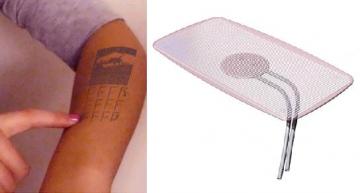
This is the kind of body-mesh with technology I like to see. I see a couple of problems with it however. While they may have solved the power problem, the saving of information is something that I don't know how they will successfully achieve until large memory storage chips that are super thin are produced. Another problem is more stylistic than functional for me. I would imagine having the tattoo on the inside of your forearm would better suit the needs of the user. Perhaps they can go with a clam shell design and have flip pads on both sides. Moreover, I wonder how this would compete with designs that incorporate the phone into the eye and ear, allowing the user to see in full color and not have to speak into their arm? It's all very Transmet though, so I love it anyway.
Tuesday, February 26, 2008
I hear your band has sold your guitars and bought turntables
Robotique Majestique - Ghostland Observatory
An hour of listening and I can already tell this album will make it onto my regular car rotation. Now if only they would play a proper Dallas venue.

Three Days Later - Review: Finally Punk
Hyperrealism, The Production of Space and Dialectic Materialism
Since I've been reading Henri Lefebrve's The Production of Space along with some minor research in the fields of hyperrealism and supermodernism, I've had to relearn the dialectical and the differences between Hegel's notion of the dialectic and Marx's dialectical imperialism. I know, I know, I should still know this but I tended to avoid anything that smacked of Marxism when I was in school. Now the off-shoots and intellectual movements sparked in response to Marxism I've been all over. Lefebrve, in writing on the production of space, is taking it from a Marxist perspective, sort of. Thus the dialectical is important. For Marx, the dialectic was the attempt to transcend the contradictions of the material world in order to attain a new height of history and human experience. Lefebrve believes this kind of attitude towards space (space meaning social space, mental space and material space) overlooks the necessity of both the distinctiveness of different kinds of space while admitting their intertwined relation.
For me, this attempt to span the contradictions of the human experience shows a misunderstanding of what the human experience really is. Camus spoke of this in The Rebel as the concepts of freedom and justice are constantly at odds with each other, neither existing without the other but without any foreseeable way of reconciling that conflict. It's a matter of not 'transcending' the contradictions of the world but allowing those contradictions to exist as is. The gap exists but it isn't a failure of philosophy. It's an acknowledgment of the limitations of the human mind. The dialectic originally meant, in the pre-Hegelian sense, a way of reasoning to arrive at a truth. Hegel and Marx turned it into some world-historical method to achieve a more perfect form of history and humanity when none was needed. Even though the dialectic has allowed us to realize the limitations of human logic it is not a system that one should take too seriously. Instead, I think the dialectic is a starting point for understanding those limitations and realizing how production in the Marxist sense is only one way to look at things. Postmodern, it may be, but it also fits within the realm of the hyperreal as attempting to expose the contradictions of the simulated reality of hyperrealism is an important task for futurists as well as philosophers.
Ohio Debate Recap
I think Sen. Obama succeeded quite nicely in parrying Sen. Clinton's thrusts while not appearing to draw too much blood from her. Moreover, I think Sen. Clinton inflicted her worst wounds on herself (her snark about receiving the first question and whether Sen. Obama needs more pillows for his ass was particularly stupid). It was good that the debate over healthcare was dispensed with first as it has dominated the last couple of debates. Refreshing arguments over foreign policy, campaign tactics and rhetoric were welcomed.
Sen. Obama owned the first half of the debate but had a weird return after the commercial break. Sen. Clinton looked far more composed after that break which leads me to think that perhaps the 'kitchen sink' routine her campaign was promising wasn't so promising a tactic. Still, Sen. Obama kept his professorial air about him and never seemed fazed by some odd questions. His response to the Louis Farrakhan endorsement, while a little stilted, was appropriate and segued nicely into his potential problems with the Jewish vote. I think Sen. Obama could go a long way to repairing the divide between Jews and blacks in America. On the other hand, Sen. Clinton's 'me too' addendum to that question was rather self-serving.
The NAFTA question and the foreign policy questions were clearly Sen. Obama's best arenas. He struggled a bit with the public financing pledge, parsing his words carefully in a way I wasn't quite comfortable with. But I do take comfort that the way the Obama campaign has gone about raising fund through small donations goes a long way to supporting him philosophically if he doesn't take public financing, since, in a way, he already has.
Sen. Clinton had few moments to shine. Her closing remarks were good but not as good as in Austin a week earlier. Her defense of not releasing her tax returns was strained at best and her decision to continue hammering her 'fighter' aura was strange considering who the Democratic nominee will face in the general election. But at least she finally recanted her AUMF vote. I doubt that will do much good now but at least she made the effort.
I did like how both Russert and Williams continued to pressure the candidates for more direct answers and kept them within a certain set of time limits. The moment that Brian Williams had to cut off Sen. Clinton was both snarky and brilliant all at the same time. Overall, I enjoyed the MSNBC moderators better than CNN's. While there were a few good questions in the last debate, Sen. Clinton derailed them too often. This time around she wasn't able to do that and thus wasn't able to score some serious points over Sen. Obama.
In the end, Sen. Obama didn't exactly blow Sen. Clinton out of the water but he did continue to do what he has done in ever other debate. He remained claim, considered and composed at whatever was thrown at him while Sen. Clinton seemed to struggle at times once the healthcare debate passed. It was a good debate and Sen. Obama's refusal to let himself get drawn into a pissing match allowed him to maintain his presidential look. If he's able to keep this kind of attitude during the general election debates then there's no reason why he can't overwhelm the more antagonistic Sen. McCain. But there's still next Tuesday to get through and we'll see who has the nomination locked up by then.
Best Live Blog Quote
10:32 — "Barack: You know what I regret? Meeting God when I was 22, and becoming divine and immortal. Sometimes I want to live among the humans, you know? They have such nice things." The Wonkette
Monday, February 25, 2008
Like LBJ, Sometimes My Dick is the Answer
This post both confirms and denies my academic/nerd cred. I changed my own brakes yesterday on all four wheels. Six hours of sweating, unbolting, clamping down, plugging in, fitting, sitting, and seating. My hands still hurt and my knuckles look like I've been in a fight, which in a way I was. Not only did I save money I put higher performance brake pads on. Now I just need to find some big money for slotted rotors. What is it about taking things apart and making them better that appeals to me? I do it to my computer, to philosophical theory, to history, to just about everything. I guess it's just a character flaw in me, obsessiveness and single-mindedness. Maybe that's why I'm terrible at answering phone calls or IM's.
Being a Grammar Nazi
Clinton: Obama is to Foreign Policy as Bush was to Foreign Policy - Marc Ambinder
“We’ve seen the tragic results of having a president who didn’t have neither the experience nor the wisdom to manage our foreign policy and safeguard our national security. We can’t let that happen again.”
Now I'm not one to nit-pick (actually, I am) but the first sentence is really bad: "didn't have neither"? I can understand when giving speeches one can get their words a little mixed up but for someone like Sen. Clinton to make a freshman mistake like that is just silly.
On a more serious note, Sen. Clinton just made it easier on Sen. McCain on the national security front. If an election between Sens. Clinton and McCain was decided solely on foreign policy experience alone then Sen. Clinton would find herself beaten a foot into the ground by Sen. McCain. It's simply stupid of her to go on the attack on foreign policy when she doesn't have much of one and to claim experience in the matter when she will face a giant in the public's mind on national security.
One-Armed Political Fighting
The Foreign Policy Failure - Matt Yglesias
Yglesias makes a salient point here concerning the foreign policy positions of the two Democratic candidates. Sen. Obama has made it clear for some time now that he has put together a serious and dramatically different foreign policy than Sen. Clinton, who has attempted to avoid any deep probing of the issue. More than just the issue of meeting with our enemies are the issues of weapons technology and nuclear stockpiles. Yet the mainstream media has failed to grapple with the issue in any real way, most conspicuously in the arena of op-ed pieces. Yglesias points out that in the case of the Washington Post their op-ed staff lack someone who would tackle the foreign policy issue of the Democratic candidates in anything approaching even-handedness.
This lack of attention becomes a problem for the candidates, most particularly Sen. Obama, when their is little distinction between their domestic agendas. While Yglesias makes the point that the president has a greater freedom of movement in the foreign policy arena, I think the more important point is that the lack of foreign policy discussion has allowed not only Sen. Clinton to avoid any serious embarrassment during a debate, it has allowed Sen. McCain the opportunity to go unopposed when he turns his attention to foreign policy in his speeches. For a presumptive front-runner like Sen. Obama to have half of his entire policy agenda ignored is strange and potentially harmful when it comes to countering Sen. McCain's policy points. Outside of the regular blog readers, the majority of the public has little in the way to assess Sen. Obama on national security, an important issue for many still.
Saturday, February 23, 2008
Shame On You!
Clinton Unloads on Obama's 'Destructive' Tactics - WaPo
So Sen. Clinton has decided to go on the attack about health-care a week before a debate on a network her campaign claims is against her. Also she decides to call out Sen. Obama on campaign tactics, thus opening up the debate to questions about her desire to seat the Michigan and Florida delegates along with her attempts to persuade the super (or automatic if you prefer) delegates to override the popular sentiment of the public thus far. Oh, and she complains about how Sen. Obama is able to draw large crowds. See for yourself and think it over.
Personally, I see a Senator losing her shit on national tv over ads that have been in circulation for a while now. I'm puzzled though. Why now? And why in this way? The video makes her look angry and verging on unhinged. Why bring up campaign tactics when her campaign has made the biggest missteps so far and has used far more underhanded tactics? Why attempt to force an entire debate on the one issue she has some seriousness about, health-care, when the moderators aren't going to let her do that. Unless she plans on taking over the debate and looking even more unhinged in the process, she will have to calmly detail where Sen. Obama is wrong and how. Moreover, she will have to rile Sen. Obama up to make him look like an angry black man, but thus far he has taken the hits with a cool sense of confidence and an air of wisdom about him. The soundbite lines Sen. Clinton has thrown out have all fallen flat while Sen. Obama continues to produce speeches that pull on the best of past speakers and his own sense of good rhetoric. The Hillary Clinton I saw today differs vastly from the calm and sensible Hillary Clinton of this past Thursday's debate. It's as if no one in her campaign told her about the fliers until today. Very strange.
Thursday, February 21, 2008
Austin Debate, pt. 6,973
So the quick consensus is that the debate wasn't a knock-out for either candidate but that Sen. Obama still won since he made no major blunders. For some reason though, the common wisdom is that the defining moment of the night was Sen. Clinton's closing remarks, in which she nearly verged on tears. Some say she was showing genuine emotion while others say that she recognizes the position she is in and will place party over her own ambitions to concede the race to Sen. Obama. Somehow I don't think that's the moment most people will remember. I think her stupid science lab experiment of a line about Xeroxed speeches will resonate more. I believe Sen. Clinton was soundly beaten and showed it in several different ways. The first was that idiotic poll-tested line and then her ignoring the question of a Latino so she could continue talking about health-care and ending with her overly sentimental closing statement. She didn't look presidential nor did she act like one. Sen. Obama didn't knock her out, she did it to herself, and if the CW is right, Sen. Clinton knows that she will remain a Senator.
Best Live-Blogging Quote
9:24 PM — There is definitely a healthy breeze onstage, as evidenced by Obama’s flapping notepad. Maybe it is the radiance of Hillary’s hate.
- From the Wonkette
Spot the Price
Currencies and Commodities @ NYT 4:00PM CST
Watch me bitch about metal prices for a moment. Let me just say tha $940 for a troy ounce of gold is fucking ridiculous. And $2,100 for a troy ounce of platinum? My god, who is buying all of this? It can't all go to computer parts and catalytic converters. If you want a sign that the economy is shaky just keep your eye on the spot prices for precious metals. Three years ago a troy ounce of gold fetched around $350 to $400. Fucking ridiculous.

A Diamond for Vandels
Weaponized Diamond Engagement Ring - Cory Doctorow @ BoingBoing
Now that is cool, but not surprising considering how hard a diamond is. But what I think people don't realize that if you hit a diamond in just the right way, you can shatter it. So while this might look cool, it's impractical and actually dangerous to the stone. There's a reason why the old European cuts have a dot in the center when you look at the stone from the very top; people were afraid of breaking that point, the culet, off.

North American Scum
Okay, before we all forget about the Michelle Obama gaff in light of Sen. McCain's lobbyist problems I wanted to mention a couple of things. Now remember, I'm a supporter of Sen. Obama so go into reading this with that bias in mind. Even so, I do believe it was a gaff as a statement that she should have couched far more carefully than she did. I can understand the reasoning behind it, for the last twenty years of politics in America there have been few opportunities to feel proud of one's country. Love of country is one thing but we aren't always proud of our country, just as we aren't always proud of the people we love. But sometimes moments, events, history happens that make us stop and realize how good being an American feels.
I remember feeling a sense of pride after 9/11 when, for a brief moment we had a shared purpose, a real sense of unity, even if that unity was brought about by fear. But my experience of America is limited as my consciousness of the world didn't take shape until I was nearly in my teens in the early 90s. So I went through all of the Clinton years and the Bush years with few moments to find pride in my country. I can see Michelle Obama suffering from the same lack of pride as I did. Conversely, I can see Mrs. Obama as feeling an overwhelming sense of priding in watching a black man, her husband, have a genuine chance of becoming the president of the United States. Now if that doesn't make you feel damn proud then you obviously have a skewed sense of what pride for this country means.
As far as gaffs go however, I don't believe this is a serious one. Moreover, in a campaign so well run, this is the first mistake that even rises to the level of a gaff. Yes, some people are offended, but in general they are the same people who wouldn't have voted for Sen. Obama anyway. The damage done to the Obama campaign is at best minimal. It comes across as the same hullabaloo that Sen. Obama caused when he explained why he doesn't wear an American flag lapel pin; he's an American damnit, he doesn't need to advertise.
I think the best way of framing Michelle Obama's words are through LCD Soundsystem's song "North American Scum". Yeah, sure, Europeans look down on us, but this is our country and we love it, warts and all.
Wednesday, February 20, 2008
Ill Communication
No blogging tonight. I'm crawling into bed to listen to another rehash of a new mix tape. I hope she likes it.
Tuesday, February 19, 2008
Your Lying Eyes
How Believing Can Be Seeing: Context Dictates What We Believe We See - Science Daily
It only makes sense that context would provide meaning for what we see. I remember watching part of the mediocre movie "What the Bleep Do We Know" and learning about how the natives in America at first couldn't see Columbus' ships or Umberto Eco's description of native American's first experience with armored men on horses and how the natives believed the horse and the man to be one creature. When we see things that are outside of our contextual background, our minds attempt to take up the slack by interpreting the visual into something that makes sense or, in the case of the unseen ships of Columbus, completely block it from our sensory experience. Simply put, the neurons of perception are firing but they have nothing to connect to, nowhere to go.
It's a matter of how our minds categorize the world. Before the rise of Gothic literature in the 19th century, many of our fears about science overtaking man or the idea of playing God remained undefined and outside of our experience. Once Gothic literature came about we had a reference point from which to expand our experience and make the subconsciously frightening something less fearsome. Once we can put something into words, into language, can we examine it in a logical fashion. But that which remains outside of our logical realm are either ignored or unconsciously feared.
Plagiarism
Being of the academic mindset I tend to favor the citation of another author's work in one's own work. But the tempest in a tea pot that the Clinton campaign is making over Sen. Obama's speeches and his sharing of lines between him and Gov. Deval Patrick does not seem to rise to the charge of plagiarism. It's common practice among public speakers to use words and rhetoric from others to bolster their own speeches. And with the case of Gov. Patrick, it seems that not only has the governor given Sen. Obama his consent to use some lines of his speeches, but Gov. Patrick himself has used lines from Sen. Obama's speeches as well. Yes, perhaps Sen. Obama should preface the use of those lines with where he got them from but as long as he isn't, ala Joe Biden, lifting entire speeches without giving due credit then it's not plagiarism, it's recognizing good speechwriting that dove-tails into one's own ideas. If what Sen. Obama does is plagiarism then every time he uses Biblical references, or calls on the rhetoric of MLK or any other civil rights leader then every politician is guilty of plagiarism. Particularly in this instance, there's a case to be made that the Clinton campaign has lifted an idea from the Obama campaign when they altered the rally chant of 'Yes We Can' to 'Yes She Can' for their own purposes. To say that what Sen. Obama has done is plagiarism and what their own campaign has done isn't seems far-fetched, to say the least.
Now when it comes to Sen. Obama's backing away from public financing for the general election, one has to remember that his pledge was predicated on Sen. McCain being the nominee for the Republican party and then negotiating out what is acceptable and what is not. Since Sen. McCain is already gaming the public finance system somewhat, I'm not sure that Sen. Obama should be held to that pledge. Such a pledge requires the assent of both parties and both parties acting in good faith. Thus, with Sen. McCain using the public financing angle to secure a loan pre-general election, I think Sen. Obama is allowed to eschew his pledge in the face of bad faith action by the other party. Moreover, I think the way Sen. Obama has raised the sort of money he needs for a general election run is vital for the Democratic party in terms of future elections. By not relying on large contributors but instead on a widely distributed network of small donations, Sen. Obama has built a campaign financing system that not only will serve other Democrats running for election in the future, but also avoids the pitfalls of taking large donations from vested interests, the kind of interests Sen. Obama has spoken out against time and time again. So once more I see the Clinton campaign attempting to make something out of relatively nothing. It's desperation on the part of Sen. Clinton and while the supporters of Sen. Clinton will argue that Sen. Obama is no better than the rest, the supporters or independents leaning his way will see that he hasn't done anything morally wrong.
Monday, February 18, 2008
Searchable Clusters
Searching the Web by Clusters: Clusty Returns Group Results - Trend Hunter
Hmm...I'm wondering how the increase of tagging and tag clouds will affect the results returned by this search engine. As Trend Hunter said, it's no Google killer but it does offer a way of narrowing down one's search.
Cognition of the Real
Nature of Consciousness: How Activity of Single Neurons in Human Brain Reflect Conscious Perception - Science Daily
My quasi-girlfriend is working on her doctorate in neuroscience; specifically on the function of single neurons and their relation to other neurons. Thus I've taken a closer interest in the scientific aspects of consciousness. The philosophical implications are still there, at least until the soul cell is discovered or whatnot. This also intersects with my interest in hyperrealism and the effects of information technology on human consciousness and social practices. I'm currently reading a several decades old text by Henri Lefebvre on the relation between mental, social and physical space. This is all jumbled in my head at the moment, but suffice to say, reading about how conscious recognition is an 'all or nothing' sort of thing when it comes to the firing of single neurons it shows some of the physical component to the mental-social-physical relationship. My question has to do with whether a simulated reality can produce the same results in the physical brain. It's all terribly interesting but probably very boring to most of you. Still, it's what gets my brain going so it's what I'm going to write about.
Brian Michael Bendis Rewrites Matt Yglesias
Ultimate Blogs - Matt Yglesias
I do so love when comics are injected into the political blogosphere.
What You Don't Know Can Hurt You
That Clinton Competence - Jason Zengerle @ The Plank
Competence - hilzoy @ Andrew Sullivan
What? There Are Rules? - Matt Yglesias
Three posts from three different bloggers all hitting the web at the same time on the competence of the Clinton campaign. The issue sparking this concern on competency is the Texas primacaucus and the surprising revelation that the Clinton camp had no knowledge of how the Texas delegate system worked until earlier this month. According to Zengerle, Hilzoy and Yglesias, apparently the Clinton campaign was counting on the Latino vote in the southern sectors of Texas as a sort of 'firewall' against Sen. Obama. Unfortunately, the way the Texas primacaucus works, it favors more urban area such as Dallas and Houston, which to add insult to injury, hold a large black population. Now, I'm not sure what the standing is in cities like San Antonio, which is predominantly Latino, or Austin, which is distinctly liberal but has a large student population.
The main problem for the Clinton camp though, is that Latinos have traditionally shown a low turn-out during primaries, something that figures heavily into the number of delegates the next primary allocates. Each precinct receives a certain number of delegates that are dependent on the previous two primary elections. So if a precinct had a low turn-out in the last two primaries then that precinct will receive fewer delegates this time around. Moreover, during the last primary in 2006 there were two independents running for governor; one coming from the Republican side and poaching Republican votes, and one, Kinky Friedman, coming from nowhere to poach independents and Democrats. So the delegate count for most precincts is lower this election cycle than in previous cycles.
That the Clinton campaign never took the Texas system into account when boasting it as a firewall state speaks more to their ignorance, and yes, competence, than their ability to predict and adapt to changing circumstances. They had a plan that started and ended with Super Tuesday and have done nothing but scramble ever since. I do hate to say this since I don't think the comparison is completely accurate, but the actions of the Clinton campaign ever since Super Tuesday have reminded me a great deal of the Bush administrations reaction to the changing circumstances on the ground in Iraq. That is to say, the Clinton campaign has gone into a serious bout of denial about Sen. Obama's chances while maintaining their own superiority. Well, after learning about their recent education on the Texas delegate system, I have to say that superiority is seriously mistaken.
Sunday, February 17, 2008
Denial is Perfectly Healthy
The First Step is Admitting You Have a Problem - John Scalzi @ Whatever
Hmm...I'm disappointed there's no picture. That would have made a good blog post.
The Supermodern as the Hyperreal as the Imagined Community
Hyperreality @ Wikipedia
Hypermodernity @ Wikipedia
I'm beginning to wonder whether the development of the hyperreal in art has any connection to the rise of supermodern architecture. Both are depictions of some beyond the reality of old. The supermodern in architecture invokes a simulated reality as it transposes context and places of rest with contextless and movement-oriented designs. Part of this has to do with the rise of the internationally recognized architect who receives bids and commissions from around the globe. Another part has to do with the business classes who travel from city to city to experience the same hotel rooms, the same airport terminals and the same rented cars on the same highways as the place they would call home. All of this, from the detachment of architecture from context to the building of simulated worlds for the business class to travel through are, in many ways, part and parcel with the ideas behind hyperrealism. The original reality become less important as the simulated one replaces it for those who actually do travel from country to country on a frequent basis. Home becomes the movement through things and a house becomes just another space to move through.
While the hyperreal in art offers a detailing of reality beyond the capability of the human mind to do by itself, it also offers a simulated reality that presents itself as somehow 'more real' than reality. How this interplay between the original and the simulation will play out in the future is something that cyberpunk writers have asked for years.
William Gibson, in describing an American's view of London as a sort of mirror world in his book Pattern Recognition, touches on that aspect of the hyperreal and the supermodern. Cayce goes from London to Tokyo to Moscow and finds the same stores, the same clothing, the same designs and the same sense of fashion. It's a simulated unity of the world through shops and attire, but then again, as Benedict Anderson argued in Imagined Communities, any identification with a group of people you have never actually met is a simulation of unity.
Viewed in this light, nationalism is the first kind of hyperrealism, as it asks us to deny the reality we see and accept that we are unified through common language, ancestry and history despite not needing to know the rest of those you are 'unified' with. Nationalism also asks us to accept the mobility of jobs and the ability to transplant one worker from one city to another, as Ernst Gellner would argue. The spiritual unity sought by the Germans and the Italians after their political unification in the 1870s could only be a simulated unification, an imagined one. Thus nationalism crafts a simulated united between people that doesn't exist in the everyday world.
Photos of the Universe as Hyperrealist Art

Personally I think this kind of art falls under the category of hyperrealism as it offers details of the world, or universe in this case, that would otherwise remain unknown to the eyes. That the radiation given off by the Cat's Eye Nebula is invisible to the naked eye is key to my believe that photos taken by the Hubble telescope belong to the realm of hyperrealist art, even if they are only photos taken with particular kinds of lenses. It's exactly that kind of human manipulation of the visual that makes this kind of art hyperrealistic versus abstract. These images are real, just presented in a way that we would have never seen before. That and I just love me some space porn like this.
The Visceral Math

There's a strange sort of beauty when mathematics is translated into art. The theories and formulas of various fields used in an artistic way produce some of the most stunning visual representations of a theorem that no description can possibly contain. The image I've used here is one created by Michael Field of the University of Houston. It's a simple creation using a simple formula, but the visual gives you an idea of what mathematics actually does in the real world, or at least is possible. Indeed, it is art, as it evokes an emotional, aesthetic response. What this reminds me of are the parasols of Japanese culture, intricate in detail but dead simple once you figure out how it works. For a nation worried about its students in the realms of math and science, I think using images like this to show how math can work in the real world would prove incredibly educational. I just wish teachers had more time to incorporate this kind of mathematical artwork into their class schedules.
Open WiFi Horizons
Give WiFi Leechers Computer Rage with Executable Command Fun - Haroon Malik @ Gizmodo
Steal This WiFi - Bruce Schneier @ Wired
I'm siding with Schneier on this one. I keep the WiFi portal in my house open for the neighbors to use, or anyone who visits the house with a wifi-capable device. I don't see much of a point in encrypting it since most of my neighbors aren't the sort to try and hack into my internet access.
Now, I do understand the situation is probably different for those of us who live in apartments and don't want someone a floor below piggybacking on your internet expenses. But that's nothing that closing the system or actually talking to the person and perhaps the rest of the tenants about a co-op wifi network wouldn't solve.
I don't see much of a point in closing off a wifi network on the basis of security or of good hospitality. The devices we use so frequently now actually require this kind of openness of wifi networks. While some cities are working on an open infrastructure it would make more sense to engage the community to open up wifi access. Plus, I have to agree with Schneier again when he says that if your computer or device is lacking the proper security then having a closed network at home or in an apartment or wherever isn't much comfort. Keeping an open network requires the users to actually keep their security up to date, which in the grand scheme of things, isn't a bad idea at all.
Bright Like Neon Love

Aside from the mad scientist desires I have for this laser, I want to see it 'boil the vacuum'. Spontaneous matter generation is one of the coolest whacked-out parts of particle physics. Finally, I have a laser that can both destroy my enemies and make me a cup of coffee out of thin air.
Rock Out
Breaking Rocks in the Hot Sun - Spencer Ackerman
Probably won't see this in the theater, but I do believe that's the best anti-Bush movie trailer I've seen.
Eras, Ages and the Fear of the Future

At the End of an Age @ Yale University Press
John Lukacs @ Wikipedia
I bought this book a while ago on a whim and only just now have read it. More historiographical in nature, Lukacs, writing at the end of the millennium, argues that we are witnessing the end of the Modern Age. Just for a point of reference, the Modern Age is said to have begun throughout the 15th century, thus making this age five hundred years old. The purpose behind dividing the Modern Age from the medieval period that preceded it is to highlight the dramatic shift in thinking that occurred during the 15th century. Of course, this terminology of Modern and medieval mark the perspective of the book as a distinctly Western one. Lukacs acknowledges this, but considers his audience a Western one and thus does not make a convoluted attempt to fit the rest of world history into the framework of Western history.
That framework is of particular importance to Lukacs, since it is his contention that our historical consciousness is changing, just as it did at the beginning of the Modern Age. But the change Lukacs focuses on is not the mere fact of having a historical consciousness, which marked the Modern Age, but that our historical consciousness is evolving into a relative one--one that depends on taking the perspective of past historical actors and viewing their future as still undecided.
More importantly, Lukacs argues that the Modern Age is ending as we have slowly realized that the hard sciences too have a relativistic perspective. In other words, that the questions and answers of past scientists depend just as much on their historical context as they do the scientific method. Werner Heisenberg figures prominantly in Lukacs' argument as it was Heisenberg who first formulated a theory that the observer and the observed are inseperable. The Heinsenberg Uncertainty Principle was a product of recognizing that observing sub-atomic particles affects how those particles act. To put it simply, we can either know the position of a sub-atomic particle with a great certainty or we can know where the particle is going, but not both.
Leaving the science aside, Lukacs is more concerned with the metaphysical implications of Heisenberg. Lukacs' argument rests on that melding of the mental and material worlds as he believes since we cannot fully separate ourselves from our subjects for observation, we must recognize the limitations of Science to provide us with eternal truths and laws. Moreover, Lukacs argues that we must accept the primacy of the mind over matter, that while the universe may exist without us, the universe as we understand it depends on our historical consciousness and context.
I don't buy most of Lukacs' argument. I think he places too great an emphasis on the mind when arguing that the Universe is a product of our minds. For one, it reminds me too much of the Idealism of Berkeley. For another, I think it places to great a distance between the physical world and the mental world. His attempt to join the two together results more in a metaphysics of science versus a synthesis of the material and the mental. In part, I believe Lukacs' position derives too much from his Catholicism. To Lukacs, we are the center of the universe since our minds are what make up the universe. Strangely, this does avoid an anthropic view of the universe in a way. At the same time, it serves to reinforce the idea in the reader that Lukacs believes more in the Creation than in the idea of a universe springing into existence that just happens to have a planet to develop intelligent life. This idea is reaffirmed in Lukacs' position that history begins with civilization, or rather, that there is no 'pre' history.
Where I think Lukacs goes wrong is in his definition of the 20th century. He marks the beginning of the 20th century at the start of the Great War in 1914 and the end in 1989 as Communism fell. By focusing the majority of this period Lukacs ends up re-fighting the old battles between the Subjectivists and the Objectivists--a battle that I do not think needs another skirmish. But more than fighting old battles, I think Lukacs' narrow demarcation of the 20th century misses a great deal of the ideas and questions that informed the 20th century and only now are being asked again. The period of Western history from 1870 to 1945 is of greater importance to the 20th century than that of 1914-1989. While the 19th century is considered a long one, from 1789 to 1914, there are distinct sections in its intellectual history that had an immense impact on how the 20th century started. The fight between the positivist and the anti-positivists (or romantics if you like) was reaching a conclusion in the 1890s but was placed in a temporary stasis during the Great War, only to re-emerge in a slightly twisted version during the 20s and 30s.
World War II put an end to the questions of the fin-de-siécle and left Europe in a brief intellectual wilderness out of which emerged the Objectivist and Subjectivist veins of literary theory and sociological study. Part of that division in theory was based on politics. The New Left and the rise of the neo-conservative during the 50s and 60s resulted in some ridiculous intellectual battles during the 70s and 80s. It was only after the fall of Communism that the West was able to resume its questioning of what Modernity means and how morality, the mind and existence fit in with this new and rapidly changing way of life.
Unfortunately, Lukacs ignores most of this part of the West's intellectual heritage. I find it even more unfortunate considering the rise of the cyberpunk genre of literature, television and film. I do believe that we are in a transitory period, but whether that is from one age to another or simply part of a larger extension of the Modern Age I cannot say. The concern with how the mind interacts with the material world is a valid concern. Thousands of questions remain, in philosophy alone, over how the mental and the physical interact. And with the integration of the Internet into our lifestyles and the implications that brings with it will only increase the urgency of these questions. It is the existence of cyberpunk that leads me away from the conclusions of Lukacs. There is something new and different on the way, that much I can say. But what it is and how it will shape the mind of the West and the rest of the world is that big unknown, an unknown that Lukacs seems to fear.
Saturday, February 16, 2008
Ways to Piss Me Off
Imagine - Ezra Klein @ The American Prospect
Klein has an amazing ability to piss me off about just the wrong kind of things to piss me off about. What makes matters worse is that he pisses me off about things that Matt Yglesias would recognize in a different and generally more correct way. In this instance, Klein attempts to take Yglesias to task in the third paragraph for saying that one could imagine Sen. Obama's ability to persuade as a useful tool to pass legislation. This, coming after a paragraph where Klein once again knocks Sen. Obama for not having a mandated health-care plan. It's the same problem I have with some of Sen. Obama's more fanatical supporters and some of Sen. Clinton's more fanatical supporters. The constant citation of Sen. Obama's oratory skill, either as a way of dismissing what Sen. Obama has to say or to show that he is covering a timid kind of politics, misses the fact that Sen. Obama is still a politician. He's not the Messiah for Christ-sake so stop treating him like one. That he has garnered unheard-of support from the youth of the Democratic party is something that Democrats should shout from the roof-tops, not bash as some sort of bait-and-switch technique. Even so, he is a politician and a pragmatic one at that. What Klein calls timid is more of a sign of Sen. Obama's ability to make the first steps in a good direction without overreaching too early.
One of the main problems I have with a great deal of politician's promises is that they offer too much without talking about how they might get these proposals passed. Presidents have a great deal of power in terms of what the nation talks about but they cannot, unless they act like President Bush has, ramrod policies down the throats of Congress. That Sen. Obama is promoting himself as a different kind of politician doesn't deny him being a politician, just one that's not going to offer you the sky and the moon to get elected. His policy positions are starting points, not end point, which is where I get so infuriated with political promises because when these end-step kind of policies are bandied about no one talks about how the policy will make it through Congress in any form similar to the one originally offered. Sen. Obama instead, has the guts to actually make policy proposals that those of other parties can get behind without making it seem like they are betraying their party. To call it 'timid' is to misunderstand the appeal of Sen. Obama in terms of policy. He gets enough of the legislative process to know how laws are passed and knows not to offer something that has a good chance of crashing and burning on the floors of Congress.
Euthanasia
I had a headache. It was cold, wet, a February day like the one my grandmother was buried on. Kit was waiting in the windows, in her normal spaced-out observation stance. The big cat loves to watch slowly. It felt like a fellow inmate waiting to announce the arrival of the priest. It was another forty minutes until the appointment. Forty minutes of existence. My headache was still there. Some sort of dull throbbing in the front of my skull. Amelia was hungry. She announced it loudly. Would you feed a condemned cat? But I fed her and she ate. I had sat with her for a while the night before. She crouched down and kept her eyes low, or rather, eye. Mishu waited on the bed, interested but amazingly restraining herself from investigating. I went back to my room and sat on the couch.
"Have you said goodbye yet?" Guilt and sadness was in my stomach. I couldn't think, let alone of anything to do, only about the time to come. Finally I went to find Amelia. She had crawled back to her spot on the cable box. My head still hurt. I sat and watched and gently scratched her head. I felt worse when the purr came out in a wheeze. Her eye was low again, her head floating from side to side. I shared ten minutes like this.
The box was full of old dvds meant for sale. No better dignity was available. The cat carrier had gone. It was in the hands of a friend for a cat Amelia was soon to meet. Her body was worn away. "Sweet thing, you've got nothing left." I left an old towel in the box. Nothing but the best for the old and sick. Gently picking her up I placed her in the box. Amelia looked around and then directly at me. That accusatory eye. The headache was there still. I carried the light box to my car and sat it in the front seat. It was raining again.
I sat down, started the engine and tried my best to ignore her looking at me. The yowling wasn't bad. I was used to it. The yowling came with the age. The quiet mews didn't. The quiet mews I wasn't used to. I drove slowly but not slow. Amelia was agitated. I drove part of the way to work, or the way I would have driven. Windshield wipers running, faster cars kicking up spray. I arrived at the appointed time. My head wouldn't stop hurting. I couldn't stop saying goodbye but the words never left my mouth.
Amelia took it well, the cold and the rain. A helpful woman opened the door for me. Her sad aw's were not helpful. I stood there, at the counter, Amelia resting beside me in the box, while papers were signed, information produced and recorded and twenty minutes of a cat's life was extended. Finally, I paid my money and signed away a cat I have known longer than any friend. Two women went to lunch. Another complained about the malfunctioning bulb. The woman helping me was too quiet to converse with. And then a woman I hadn't seen before came in and ask if this old lady of a cat was Amelia, information received. In the middle of taking the receipt and papers for records the informed woman asked, "Have you said goodbye yet?"
I did, laid my hand on the back of her head one last time and then walked away. Amelia never looked up, never knew what the signatures were for, or the box and towel, the cold and the rain. She never saw me leave. She's dead now, off to meet the friend's cat who got a more respectful trip to that building and those lands. I took my guilt and headache home, perfectly alive.
Friday, February 15, 2008
Texas Primary Primer, Pt. 2
One thing I forgot to mention when talking about primary elections in Texas. No one in Texas is registered as either a Democrat or a Republican. You are only affiliated with a party when you vote in a primary election and that affiliation only lasts for the rest of that year you voted. In other words, if you vote in the Republican Texas primary in 2008 then you are affiliated with the Republican party for the rest of 2008. That affiliation ends when the calendar year ends. What the affiliation means is that once you have declared your affiliation you cannot vote in another party's primary, run-off election or any other party-affiliated function. If you vote in the Democrat primary then you cannot vote in a Republican run-off contest later that year. In addition, you cannot sign a petition to put someone not of your affiliated party on the ballot.
Now for a general election, like the one this coming November, you can vote for whoever you choose, no matter the party. So what party affiliation means is that you can participate in your affiliated party's actions but not in another party's actions. This also means that even if you are a life-long Republican or Democrat you can decide to vote in another party's primary if you haven't already voted in your party's primary.
Wednesday, February 13, 2008

Tuesday, February 12, 2008
The Texas Primary Primer
The Texas Inferno--Why it Helps Obama - Publius @ Obsidian Wings
Everything You Needed to Know About the Texas Delegation Process, Pt. 1 - Philip Martin, Burnt Orange Report
There's No Such Thing as the Texas Primary, Part II: Delegate Projections - MattTX, Texans for Obama
Texas Hold'em - Christopher Orr, The Plank
Here I've collected a series of primers on the Texas primary election this coming March. The pundits have taken to calling it a 'primacaucus': one part primary and one part caucus. At stake are 193 pledged delegates along with another 35 super-delegates. The primary election itself--the normal, ballot casting part of the election--accounts for a 126 delegates. That part is simple enough. But the rest of the pledged delegates are decided by a caucus system that starts right after the primary polls are closed. Candidate loyalists are the ones who will typically stick it out to this point. Precinct caucuses are held and then the fun begins. From the precinct, delegates are sent to the county convention, from county convention to state convention and then finally to the national convention in Denver.
There are 67 of these caucus-decided delegates and that part of the system favors the candidate who has the best ground-game and grassroots organization. So, while there are 193 pledged delegates in total at play in Texas, only the 126 primary-elected delegates are decided on the night of March 4. The final tally doesn't occur until some time in June. So those who simply want to cast their ballot can do so throughout the day of March 4th but those who wish to participate in the caucus as well must cast a ballot in the primary and then wait until the polls close. The common wisdom currently being tossed about, as you can see in some of the sites I've linked to, is that the Texas primary, while thought of as a firewall state by the Clinton campaign, isn't a state one can lock up so easily. Convoluted it may be, but it seems to me that the Texas primary offers one of the better ways of granting a voice to the people in both a popular vote and a more elitist caucus vote.
I hope this helps to of you who are going to vote in the Texas primacaucus next month. I don't know if I will participate in the caucus part of the election but I certainly will cast a ballot in the primary. I have the feeling though that my whole family will be there for the caucus.
Obama Comes to Texas
Ha! Just saw an ad for Sen. Obama running during the commercials for the mid-day news. He's already advertising in this state and the primary is still weeks away.
Texas Primary Primer Coming Soon to a Blog Near You
I'm working on a primer for the Texas primary on March 4th. There have been some good posts up talking about it since the Clinton campaign has seemingly settled on the idea that Texas is a firewall state for them. The whole thing looks a mess but I'll have something up tonight with links for those here in the state who are interested.
Monday, February 11, 2008
Review: Made in the Dark

Of course, I have to offer my disagreement. I don't believe in bands having some grand scheme in the way they release albums (except for Radiohead, who passed from this realm sometime in 1996 and came back superheroes). But I do believe that some albums are necessary in the career of a band. Where their slew of remixes and brilliant second album brought them hits and fame, this, their third album, shows the limits of their genre-jumping. The album the Pitchfork staff label as flawed but likable is probably the last of its kind for Hot Chip.
It goes without saying their production values are top-notch, but I think they will need in the future a producer who curtails some of their more self-conscious, fourth-wall breaking moments. The risk though, is that some of the fun will fall out of Hot Chip's style, but we won't know that until they ready their next album. I don't want them to become too serious. But considering their style thus far, I don't think that's too great of a risk. Either way, I do get the feeling that their next album will surpass The Warning in brilliance while maintain their album wide listenability.
The Waste Land

I've forgotten to do this enough so I'm posting about Austin act Ghostland Observatory. I've tried very hard not to like these guys, my natural tendency is to recoil from anything with any kind of hype. But their mix of glitchy electronics and spastic vocals have gotten to me, enough so that I'm actually anxious for their next album Robotique Magistique to drop at the end of the month. But for the moment I have to settle with three tracks from the forthcoming album. Check it.
Monday Roundup - Flailing Campaigns and Driven Individuals
The Big States - Matt Yglesias
Obama and the Details - Matt Yglesias
Quakes in Hillaryland - Marc Ambinder
More News About the Democrats - hilzoy @ Obsidian Wings
Stop the Thief! - Editorial Board, The New Republic
Rounding up the Monday morning posts on this past weekend's elections in the Democratic field we have Yglesias talking about Sen. Obama's policy substance and the reaction of the Clinton campaign to Sen. Obama's latest wins, also at the Atlantic is Marc Ambinder writing on the shake up in the Clinton campaign staff while Hilzoy at Obsidian Wings asks a few questions, and finally we have an editorial from the New Republic arguing against the seating of delegates from Michigan and Florida without going through a proper primary process.
First, the Yglesias posts. He tackles the anti-Obama meme that he lacks substance head on. Yglesias argues that, if anything, Sen. Obama has more legislative and policy experience than Sen. Clinton due in part to his time as an Illinois state senator and his stint as a professor at the University of Chicago's Law School. Moreover, Sen. Obama has filled his campaign staff with smart people, the kind of people who wouldn't put up with anything less than a great candidate. All of this is to say that the meme that somehow, since Sen. Obama is charismatic he must, ergo, lack policy substance while Sen. Clinton's lack of charisma equates to a serious degree of policy substance. Of course, Yglesias does point out that former President Clinton had both.
Also, Yglesias notes the habit of the Clinton campaign of dismissing any wins by Sen. Obama, finding fault with each of his wins thus claiming that Sen. Clinton has faced unfavorable odds in the states Sen. Obama won. Hilzoy echoes this idea in the first part of her post on the Democrats by pointing to the absurdly high turnout for a state that generally doesn't turn out. The point is that Democrats are turning out in unexpected numbers in unexpected states, or not so unexpected by the Obama campaign as both Hilzoy and Ambinder go on to discuss.
What both Ambinder and Hilzoy look at is the sudden fracturing of the Clinton campaign under the stress of a nomination of attrition. The self-loan of five million dollars to her campaign along with the sudden replacement of her campaign manager has people wondering what exactly is going on with Sen. Clinton. Hilzoy suspects that the campaign expected to have the nomination sewn up by Super Tuesday and were left scrambling when Super Tuesday ended the same way it started. Ambinder comes to the same conclusion that the Clinton campaign did not expect to have a continuing fight after Super Tuesday and credits that to the "superior effort" by the Obama campaign. Going through the points, Ambinder lists the failure of the Clinton campaign to meet its financing goals, its expected lead in the popular vote and its lack of substantial victories have exhausted the entire campaign staff.
What I think this points to is an inability of the Clinton campaign to adapt and adapt quickly to changing events on the groups. The more Sen. Obama speaks to more crowds, the better his numbers look, even if they don't push him past Sen. Clinton. Along with this is Sen. Obama's ground game of crafting motivated and knowledgeable campaigners in the states he needs votes. By working from the idea that he does not have a 'base' to rely on, Sen. Obama has repeatedly built grassroots state campaign staffs drawn from a wide range of voters and supporters. In assuming that he does not have a core base, Sen. Obama recognizes the need for such intensive and exhaustive grassroots efforts. While this may show in his speeches (particularly the Jefferson-Jackson dinner speech where he looked very tired) it creates that base he can rely on again when the general election comes.
Essentially, as Ambinder and Hilzoy have concluded, Sen. Obama planned for a long game while Sen. Clinton did not. That basic difference in campaign strategies shows in the delegate numbers and the voter turnouts. It also shows in campaign contributions and the strengths of their respective staffs. Sen. Obama has planned this to run all the way to the convention while Sen. Clinton must reorganize in the middle of her campaign to shift to a long game strategy. This will mean further losses for her for the next month and a potential big loss on March 4th when Ohio and Texas come up on the primary calendar. Hence the reason why Sen. Clinton is urging the DNC to seat the delegates from Florida and Michigan, something the staff at the New Republic view as an attempt to steal the campaign away from Sen. Obama through a very underhanded tactic. The TNR staff is right though in saying that the DNC needs to resolve this issue as soon as possible, either by restating their original position of not seating these delegates or holding new primaries that Sen. Obama can actually participate in.
Sunday, February 10, 2008
Political Flame Wars
Hillary Top Staff Being Reshuffled - TPM
It's not the article itself that I'm directing you to so much as the comments section. It is but a mere drop in the bucket of the bickering going on between the Obama crowd and the Clinton crowd. What I find so interesting about these near-flame wars is that they are, on average, started by the Clinton supporters. For this comment thread in particular it's terribly amusing that some Clinton supporters have accused TPM of acting as a surrogate Obama campaign site when Josh Marshall has already stated his preference for Sen. Clinton. It's a strange that these supporters seem to strike their loyalty more for Sen. Clinton than for their party. They even have subsumed a phrase from the right-wing blogs, turning 'Bush Derangement Syndrome' into 'Hillary Derangement Syndrome.' So for those who show even a sign of support for Sen. Obama they are labeled as having HDS or some kind of misogynistic attitude toward Sen. Clinton. Even Sen. Obama himself has noted this resistance in his latest speech at the Jefferson-Jackson dinner on Saturday, noting that he was labeled as nothing more than a 'hopemonger'. While I do support Sen. Obama I have struggled to maintain a proper level of rationality about the campaign, particularly when he speaks. His rhetoric is excellent but at the same time I have to remember that not all of his policies I agree with, or at the very least the way he would go about enacting them. Even so, I still believe he has a better chance at changing things that any other candidate in the field. But all that aside, the sentiments of Sen. Clinton's supporters as represented by their online voice is actually a little frightening. I find it similar to the way many Bush supporters have acted to any criticism of him. That's what I find frightening.
Yelling "Fire!" in a Crowded Chat Room
First Amendment Ruling Protects Internet Trolls - Slashdot
Muslim Groups Attempt to Censor Wikipedia - Slashdot
Spies' Battleground Turns Virtual - Robert O'Harrow Jr., Washington Post
I've long held the belief that one should use their real name, or at least a consistent online name, when leaving comments on message boards or comment pages. I think if you are going to say something on the interwebs then you should stand behind it with the reputation of your name. At the same time though, I don't think forcing everyone to use a consistent name or their real name is right. Anonymity is a good thing, even if it is sometimes more of a necessary evil than a help in online discussions. So naturally I support the court ruling in favor of allowing comment trolls to maintain their anonymity. Message boards and comment threads need such openness. It allows the poster to speak their mind, or derail a thread, without fear or reprisal. More importantly, allowing anonymity as a general rule for message boards and comments allows the moderators of various boards to maintain their own set of rules for what is objectionable content. Some can use a scorched earth policy of no foul language or troll-like behavior, others can require that you use your real name or some can leave it open and intervene only when a certain thread becomes too heated.
The free-speech issue is important to online discussions. It's also important for sites like the Wikipedia as it prevents the exclusion of ideas or images that some may find objectionable. While the Wikipedia is prone to hit jobs by politicians, interest groups and corporations among others, it does a fairly decent job of maintaining a sense of neutrality in its articles and allows for discussion of what is acceptable in an article or not. The Muslim groups criticizing the Wikipedia for refusing to pull images of Muhammad do have a point from their perspective but the purpose of the Wikipedia is not to cater to anything but those in search of information and knowledge. It would not do well for Wikipedia's reputation to pull information due to one groups' complaints.
At the same time (and this is where the necessary evil part truly lives up to its name) the anonymity of the interwebs can aide criminals and terrorists in conducting their business. While the idea of terrorist groups using online sites likes Second Life as a means of planning and plotting seems far-fetched, it isn't inconceivable. But I continue to hold to the idea that anonymity and the use of online names or avatars is right and proper for any web site. Now of course, just as one cannot yell 'fire' in a crowded room, there are instances where speech is not protected. Criminals who use online anonymity to further their interests are obviously cases where breaching that anonymity is necessary. Even so, judicial oversight in those cases is necessary as well. We should all have the benefit of the doubt when it comes to our online identities. Free speech isn't free without that benefit. Thus, while law enforcement groups may contact web admins, board moderators and ISPs for information, these groups must have the recourse of the courts to preserve the rights of their users.
So, for a brief recap: online speech is free speech; I will use my real name when making comments; I will allow anonymous comments on my blog (although I will call you an Anonymous Coward, ala Slashdot); and, while a potential threat, admins and ISPs must maintain their customers' anonymity as much as possible.
Everything is a Story
Which Book Should Neil Gaiman Put Online for Free? - Cory Doctorow, BoingBoing
The Birthday Thing - Neil Gaiman
I love ideas like this, particularly when they come from excellent authors. Neil Gaiman (of The Sandman fame if you didn't know, you heathen) has gotten permission to put one of his novels online in its entirety. My preference is for American Gods but that might come off as a little too intense for some so I'm voting for Neverwhere, one of his early novels with all of the elements of a typical Gaiman story but nothing too overwhelming. If you haven't read anything by Gaiman yet then that's an excellent place to start. With American Gods one should really read The Sandman series first, but it's not an absolute necessity. Also, if you want a taste of Gaiman but are too lazy to read, then go rent Mirrormask. The movie was directed by Gaiman's friend and incredible artist Dave McKean and Gaiman provided the script. It has a kid's movie feel to it but enough adult themes and intelligence that you won't feel insulted by it. Besides, it's a great movie anyway.
Tuesday, February 05, 2008
Wittgenstein at His Best
Ultra-minimalist political flyer, Los Angeles - Xeni Jardin @ BoingBoing
This is probably one of the most perfect examples of how Wittgenstein's language-game works. We know who she is and which war we are talking about because of sheer context alone. It's a thing of beauty.

Monday, February 04, 2008
Let the Tears Begin
Hillary Clinton cries in Connecticut - The Swamp
Oh for the love of God. If Sen. Obama teared up at an event the press would be all over him for showing weakness. But God forbid anyone criticize a woman for crying during a political campaign. I want a president who shows their emotions by doing something, not just standing there and crying. This is pathetic.
Depressed Soldier Better Fighters?

Some of you might remember this photograph from early in the Iraq war of a soldier taking a break after a long night of fighting. I remember reading an article (note: this is not the original article I read, but you'll get the gist of it) nearly a year later about this soldier, Blake Miller, who suffers from severe PTSD. It's soldiers like this that make me proud of our armed forces, but at the same time make me wonder about the stresses we as a country put them through without serious thought or care. Miller became a poster-boy for the Iraq war and now he sees Iraqis he killed walking down the street and can't seem to get over the edginess his time in the war has ingrained in him. The toll that it has taken, his wife divorced him in 2006, is something I never want to hear about from returning soldiers. My cousin-in-law, Marine of nearly fifteen years, came back from Iraq with a Purple Heart he doesn't talk about and even now he knows he will have to return to Iraq at some point in the future.
So now, via the folks at io9, I hear that depressing soldier might have beneficial effects on their ability to take on highly dangerous situations. A report Newitz has found claims that giving soldiers serotonin inhibitors would produce soldiers more likely to take risks that otherwise non-depressed soldiers wouldn't. For those of you fortunate enough not to have needed anti-depressants let me explain what serotoin and serotoin-related drugs do. Your standard SSRI (selective serotonin reuptake inhibitor) is a common anti-depressant that improves your mood by keeping more serotonin in the body. It's loosely similar to the effects of MDMA, or ecstacy, in that the more serotonin you have in the body the better you feel. By introducing a drug that inhibits the release of serotonin you are intentionally producing a depressing effect.
This kind of thinking sickens me. At a time when we have seen twice the number of Iraq veterans take their own lives than were killed in combat we have government reports suggesting that we should depress our soldiers even further? What unholy insanity is this?
Step 4: Profit!

Image Courtesy of Margaret Riegel
I came across this NYT article through Slashdot and was immediately intrigued by its subject. In philosophy there's always the issue of the 'black box' in a theory, a phrase pulled from the engineering fields I believe (a black box is a section in a theory or schematic where input goes in and out comes the desired result, but no explanation is given for what occurs within the box. Typically a black box in a theory or blueprint is its the deathknell). So Janet Rae-Dupree's article on modern inventors debunking the idea that a 'eureka' moment is what propells innovation has a certain attraction for me. Not that I believe all innovation is simply hard work, I just believe that innovation does not always require a leap in logic from nascent idea to finished product. Nikola Tesla is a rather good example of someone who could take those leaps of logic consistantly, but then again he also hallucinated a lot.
Where I do think that a eureka moment happens is when someone takes a problem or an existing product and sees clear potentials or solutions. The problem with the eureka moment isn't that it's so rare but that going from point A to eureka point Q takes a lot more than inspiration. History is filled with happenstance and chance--Napoleon falling ill before Waterloo, the failure to wake Hitler on the morning of D-Day, the WTC towers falling instead of just burning--and through those chance moments history is driven in a slightly different direction. So one must always remain open to lucky chances, to the eureka moments. Even then, the eureka moment does not instantly produce a solution or a radical new invention. The eureka moment is merely the starting point for the hard labor it takes to reach the eureka solution.
What many people forget is all the hard work that it takes to reach the eureka solution. There's a running joke on the Slashdot message boards where you have: a) a great idea; b) some money and support; c)???; and then d) profit! It's step c, those question marks, that separate those who make a successful product or a radical new theory versus those who merely have ideas that never come to fruition. No matter how good the idea or the potentially radical changes said idea might bring about, it will only happen through hard work. So don't dismiss the eureka moment, but realize what you are getting into. You still have to explain what is in that black box that separates the idea from reality.
Sunday, February 03, 2008
Tesla the Mad Scientist

Now here's something that I didn't know about Tesla. Apparently he had a photographic memory, but along with such an extraordinary ability came flashes of light, hallucinations, and detailed images of ideas or inventions sparked by certain words or images. In other words, he was a sufferer of synesthesia, or rather the mixing of sensory experiences. Makes perfect sense to me.
Travels in Hyperrealism

Jacques Bodin @ Wikipedia
Hyperrealism @ Wikipedia
Jean Baudrillard @ Wikipedia
The photo you see here is not a photo. The subject is not real in the sense of a photographed subject. Instead, both the photo and the girl are subjects of a painting by hyperrealist artist Jacques Bodin. An offshoot of the Photorealist movement from the 60s and 70s, hyperrealism differs in both narrative structure and the use of technology to paint or sculpt subject at a level of detail that goes beyond what a 35mm camera could accomplish. The hyper in hyperrealism is taken literally as most works of hyperrealism are produced to a level of detail far beyond that of real life. The dimensions of the finished product go far beyond reality as well. Most paintings and sculptures are done at an almost absurd scale. Thus by paradoxically enlarging then magnifying the detail of their subjects, hyperrealists artists amplify reality to a point of non-reality.
The original photorealists were influenced by semiotician and cultural critic Jean Baudrillard. Basing his ideas on language and semiotics around the idea that an object's meaning is determined by its prestige in relation to other mundane objects. While not as simple as Wittgenstein's formulation it does share traits such as the need for context and relation to other elements in the world. Where Baudrillard breaks with such older theories and joins with his contemporaries Foucault, Lyotard and Lacan in his postmodernist thinking about how reality is perceived and treated in the larger-scale social structure. It is on this point that Baudrillard intersects with the photorealists and hyperrealists. As the relation between object and subject becomes magnified to the point of absolute minutia as the subject (people, you and I), in attempt to gain a total understanding of all reality, becomes lost. Once lost, the subject ends up creating a simulation of reality in their mind. Reality, in this sense, becomes non-reality and to the subject the simulation is more real.
I don't buy most of it, since I never bought into Berkeley's idealism or the theory that perception is so fallible that we never have a truly unmediated experience of reality. Then again, I think Baudrillard did have an understanding of how technology like virtual reality and social networks create a simulated reality that, for some people, becomes more real than the real world itself. The acronym IRL (in real life) is a pretty convincing point of evidence for Baudrillard. Even so, to say that an unmediated experience of the real is, for all intents and purposes, impossible goes beyond what I'm willing to accept as a sentient creature whose grey matter is based on a lizard brain. If you can prove to me that lions chasing down gazelle are also seeing a simulation of reality versus an unmediated reality then perhaps I'll buy into Baudrillard.
But despite my criticism of Baudrillard, his influence on the artistic movement of hyperrealism does expose some of the flaws in the human experience. There are grey areas of experience where we have difficulty telling between the real and and non-real. Our perceptions and beliefs are prone to trickery but this has long been known. It's our ability to winnow out the real and non-real that make the human mind an amazing organism.

Yes We Can
My sister has raved about this all day. I haven't figured out all the faces in it, but most of them I have. Watch and realize why electing Sen. Obama is more important that electing the first black man or the first woman as president.
Update: So according to Truemors this ad was commissioned by MoveOn.org after they endorsed Sen. Obama on the 1st of February. The vote to endorse was an overwhelming 7:3 ratio of Obama to Clinton. So I don't think MoveOn is doing anything beyond giving their chosen candidate the best support they can give.
Fear of a Black President
Pro-Clinton Push Poll Erupts in CA - LA Times
Via TPM, who themselves have spent a lot of time examining the push polling of Republicans in the last two election cycles, comes this tidbit of information on the Clinton campaign push-polling undecideds and independents in California days before the primary election. For those of you who don't know what a push-poll is, think of a telemarketer calling you to convince you to buy their product, except they present themselves as your typical survey taker. The questions asked are designed to place the preferred candidate in the most positive light while slamming every other candidate. Now during the last election cycle, push-polling and robo-calls were the bread and butter of Republican campaign tactics. That the Clinton campaign has resorted to such Rovian tactics is telling of how much the Clintons fear a black man and to what lengths they will go to win an election.
Never Let Me Down
U.S. Pulls Plug on Low-CO2 Powerplant Project - Slashdot
Wait, let me get this straight. The U.S. government is withdrawing its support for a FutureGen coal-fired powerplant that had a way of trapping CO2 emissions all because the projected costs went 800 million over what was an expected billion dollars? The same U.S. government that has for years pumped billions into Iraq? Into 'advanced' aircraft design? Into the Future Warrior system that doesn't work? The same U.S. government that has given billions in subsidies to the coal and oil industry? But a simple plan that might have kept coal as a viable power source for another decade that runs 800 million over budget get axed? Jesus tap-dancing Christ, can this administration do anything right? My fucking God, it does not take a genius to figure out what a boon U.S. involvement in the FutureGen project is and now this? I'm going to go burn some tires and beat up babies now.
The Spherical Cow of Language
Language as a Spherical Cow - Science Blog
And once against Chomsky gets it wrong on what language is and does. This is what happens when to attempt to take the context out of language. Wittgenstein still has the best explanation, in my opinion, and I have yet to come across a better theory of language that explains as much as Wittgenstein's 'meaning as use' and the language-game theorems.
Magnetic Reconnection = Cosmic Bombs
New Discovery On Magnetic Reconnection To Impact Future Space Missions - Science Daily
I really don't get the theory or the tech speak behind this article. All I know is there's a possibility of giant random explosions in space. That's enough for me.
A Dark Fluid Beating at the Heart of the Universe
Particle Accelerator May Reveal Shape of Alternate Dimensions - Science Blog
New Light on Dark Energy - Science Blog
Dark Fluid: Dark Matter and Dark Energy May Be Two Side of the Same Coin - Science Daily
The search to discover what dark matter and dark energy are have buggered particle physicists and cosmologists for more than a decade. On the other side of this is the role that the extra dimensions string theory require might play in how dark matter/dark energy affect the large-scale structure of galaxies and the universe as a whole. Dr. Hong Sheng Zhao's theory that dark matter and dark energy are simple two elements of a singular dark fluid. If the new LHC that is coming online soon can show similarities between the particles and dimensions produced in particle collisions that match the idea of dark fluid then we might see a leap in understanding of how the expansion of the universe occurs and what the other 96% of the universe is made of. Those extra dimensions, I think, are key to where this dark energy or dark matter reside. It's just a matter of crafting a theory that explains both the effects of dark fluid (dark matter/dark energy) on the large-scale structure of the universe and how, if this dark fluid exists, is hiding within these extra dimensions.
Flash Mobs Mob Grand Central Station
207 Pranksters Stand Still for 5 Mins in Grand Central Stn. - Cory Doctorow @ BoingBoing
Cory Doctorow has posted about a flash mob in Grand Central Station. No, they didn't do anything like open umbrellas or suddenly start singing old Boy George tunes. No, they, simultaneously, froze in place for five minutes. Apparently a crowd gathered around in amazement and when the five minutes was up everyone suddenly started moving again, this time to applause from the gathered crowd. Now this is the power of SMS, IM and other micro-texting applications like Twitter. Flash mobs are one of the coolest developments of Web 2.0 and instantaneous communication. I'd like to see more of the in American culture.
Obama the Giant
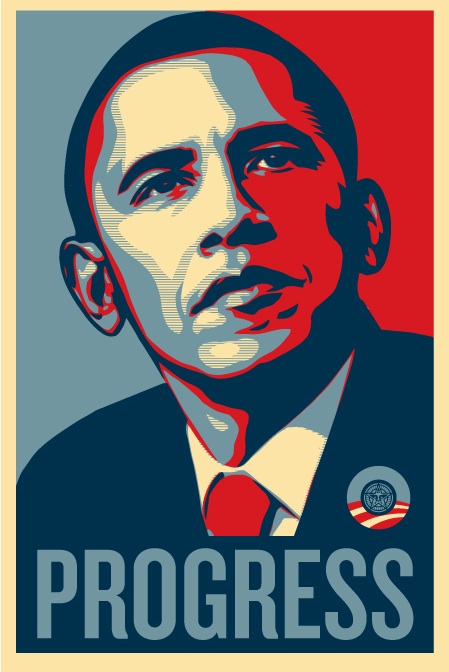
Obama @ Obey Giant
I love these aesthetic of this poster and of several of the t-shirts I've seen of Sen. Obama lately. It recalls the Che Guerra shirts one tends to see on college campuses. I've actually wanted one like that of Huey from The Boondocks for some time now. What makes the poster interesting, but fitting, is that it was created by the same artist who created the black and white Andre the Giant poster. Unfortunately the print run is sold out and according to the web site no other print runs are planned at this point. Still, I would love to see ad walls covered in posters like this.
Waiting for 2012
There are 200 'Real' Superheroes in the United States - Kevin Kelly @ io9
Damnit, Grant Morrison was right.

Taking to the Streets, Taking to the Blogs
Why I Love the Horse Race - publius @ Obsidian Wings
Publius has posted an interesting view on the horse race that has been this primary election season. He's gone meta with it and examined the aesthetics of this election year, pondering the Political versus the political as candidates of a very diverse range compete against each other in sometimes hostile territory and in combative ways. For me, while I love talk of the Political, I've found another positive benefit from this primary season--that my parents have started to pay attention to the political blogs. More to the point, they're reading the good blogs too, the ones that shirk from the shrill and focus on the factual and intelligent. Whether that lasts I cannot say, but that they are no longer relying on the tv news pundits for opinions says a lot about how this primary season has inspired them to involved themselves, at least on the informational side, in this race. I don't know how many stories there are similar to mine but I'm sure many of my generation have seen their parents take to the blogs as well. Now that's a sea change my friends.